Vending Machines Market


Vending Machines Market Size, Share & Trends Analysis Report by Technology (Automatic Vending Machines, Semi-Automatic Vending Machines, Smart / IoT-Enabled Vending Machines), by Product Type (Food Vending Machine, Beverages Vending Machine, Tobacco Vending Machine, Others (Electronics & Accessories Vending Machines, Flower Vending Machines)), and by deployment location (Transportation Hubs, Educational Institutions, Healthcare Facilities, Hospitality And Leisure Venues, Corporate Offices, Others (Residential, Retail Malls)), Forecast Period (2026-2035)
Industry Overview
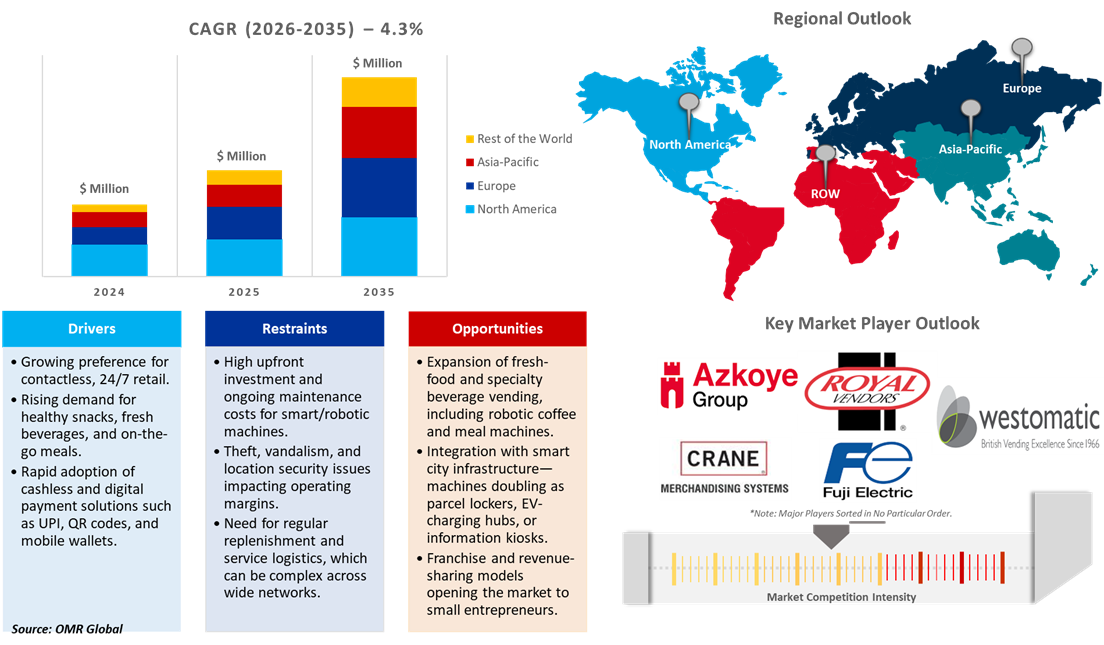
Vending machines market was valued at $21.75 billion in 2025 and is projected to reach $32.83 billion by 2035, growing at a CAGR of 4.3% during the forecast period (2026–2035). Vending machines are automated systems that allow the customer to buy a good by inserting a form of payment and receive the selected item without any human interaction. As technology continues to advance rapidly, machines are evolving into advanced vending machines with touch–screen selections and real-time tracking of inventory, also with enhanced interface functions to improve operational efficiency and enrich consumer experience with the machines. Their ability to operate 24/7 with low labor and operating costs boosts profitability compared to traditional retail formats. The availability of machines in workplaces, shopping malls, transportation centers, educational institutions, and, particularly, rural areas and communities increases consumer access to vending machines, thereby driving adoption. Vending machines are becoming increasingly versatile. Products range from snacks and beverages to electronics, personal care products, and PPE, and are increasing the product market potential. Combined, these factors can increase global adoption, including in the US, leading the way.
Market Dynamics
Diversification of Products Offered by the Machine
Modern vending machines are no longer limited to snacks and beverages; they now dispense a wide range of items, from fresh food, coffee, and health supplements to electronics, personal care products, and PPE. This broader product mix caters to changing consumer needs and opens new revenue streams for operators. Vending offers customers a convenient and comfortable shopping experience with a variety of products, a variety of payment options, and the availability of goods in areas where brick-and-mortar shops are not possible. By adapting to trends such as healthy eating, on-the-go lifestyles, and niche retail demands, diversified vending solutions are attracting more customers and expanding into locations such as offices, gyms, hospitals, and transport hubs.
Technological Innovation & Smart Automation
Modern technologies are transforming traditional vending machines into smart, interactive self-service systems. Shoppers now enjoy the ease and security of cashless payments, whether through contactless cards, mobile wallets, or even digital currencies. AI-driven product recommendations, IoT-based inventory tracking, dynamic pricing, and remote monitoring all help streamline operations and improve the customer experience.
In June 2025, Royal Vending, leading manufacturer of refrigerated beverage vending machines in Australia & New Zealand, officially launched its UK operations, delivering a new generation of Smart AI Fridges and Vending Machines that combine intelligent automation, sleek design, and total convenience. In addition to enabling new entrepreneurial opportunities for budding entrepreneurs to enter the vending industry. Royal Vending UK does this through its established vending machine business starter packages.
Market Segmentation
- Based on the technology, the market is segmented into automatic vending machines, semi-automatic vending machines, and smart / IoT-enabled vending machines.
- Based on the product type, the market is segmented into food vending machines, beverage vending machines, tobacco vending machines, and others (electronics & accessories vending machines, flower vending machines).
- Based on the deployment location, the market is segmented into transportation hubs, educational institutions, healthcare facilities, corporate offices, hospitality and leisure venues, and others (residential, retail malls).
Beverages Vending Machine: Maintain the Largest Revenue Share in the Vending Machine Market
Drinks remain one of the strongest drivers of vending machine sales, accounting for nearly a third (around 31%) of annual purchases. Popular options include traditional soft drink brands such as Pepsi or Sprite, as well as energy boosters such as Monster and Red Bull. Though there is a growing trend to pursue healthier lifestyles, many consumers still consume canned/bottled sodas as they have over the last 10 years. In the past decade, shopper behavior has changed to be a bit more intentional. Now, most consumers use a vending machine, knowing exactly what they want, not having to choose suddenly between a healthier option and a snack.
Smart / IoT-Enabled Vending Machine Segment to Lead the Market
Smart vending machines are changing retail and IT asset management by providing a more seamless and efficient user experience. They have cashless payment methods and interactive touch screens, enabling users to view product details before purchasing. These machines can be programmed to vend anything from electronics and cosmetics to apparel, food, and beverages, serving a variety of businesses to include virtually any product line. Unlike a traditional vending machine, the smart vending machine does not require a manual check of the stock, as the machine comes equipped with sensors, cameras, and real-time data available for monitoring. Companies are increasingly adopting advanced technology, such as Artificial Intelligence, the Internet of Things, and cloud software that enhances real-time inventory, predictive maintenance, personalization, and remote management. All options are invaluable for increasing operational efficiency and revenue opportunities.
For instance, in August 2025, Coca-Cola launched a line of AI-driven vending machines in New Zealand that are designed to offer a faster and more personalized experience for consumers. The machines, called Coke&Go, allow customers to open the cooler door using their smartphones and then use product recognition technology to finalize purchases through their connected payment options. The vending machines also incorporate smart inventory tracking to ensure they are stocked with the right beverages at the right time.
Regional Outlook
The global vending machines market is further divided by region, including North America (the US and Canada), Europe (the UK, Germany, France, Italy, Spain, Russia, and the Rest of Europe), Asia-Pacific (India, China, Japan, South Korea, Australia and New Zealand, ASEAN Countries, and the Rest of Asia-Pacific), and the Rest of the World (the Middle East & Africa, and Latin America).
The North America Region Holds the Largest Market Share
North America remains a leading region in the global vending machine market. The United States leads the world in the number of vending machines and has been at the forefront of their commercial use since the 1880s. As of 2024, there are roughly 4.6 million vending machines in the United States. Around-the-clock availability makes vending an easy way to generate steady revenue—on average, about $100 per machine each week, and in high-traffic locations, earnings can climb to several hundred dollars. Today, US machines sell an impressive variety of products, and even major brands such as L’Oréal and Coca-Cola partner with leading vending machine manufacturers to showcase and promote their products through this always-open retail channel.
The Asia-Pacific Region Maintains Strong Market Position
Asia Pacific’s vending machine market is growing rapidly, driven by fast urbanization and a rising preference for convenient, on-the-go access to food and essential products. Japan remains a mature market with dense machine penetration, supported by advanced technology and strong consumer acceptance of self-service. Japan has an estimated five million vending machines, which works out at one vending machine for every 25 to 30 people. Japanese vending machines accept many different types of payments, the most popular form of which is a commuter pass. It’s a pass that’s bought by the employer, which enables them to get to work and back using the country’s public transport system. Meanwhile, China, India, and Southeast Asian countries are witnessing robust expansion fueled by a growing middle class and higher disposable incomes.
In addition to this, rapid urbanization activities and the development of smart cities (along with new bus, railway, and metro stations), especially in developing economies such as India and China, are also driving the vending machines market during the forecast period. Moreover, the increasing number of corporate and multinational offices will also aid in the growth of the market.
Market Players Outlook
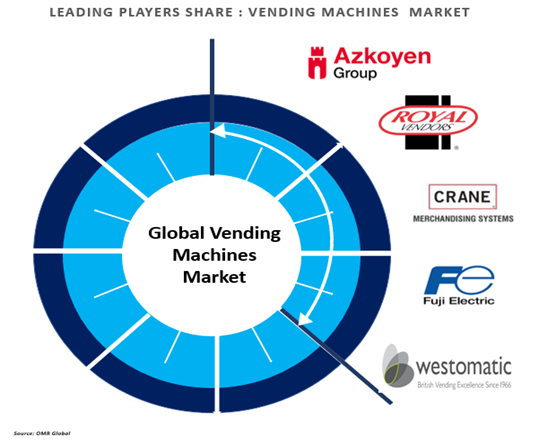
The major companies operating in the global vending machines market include Azkoyen Group, Crane Merchandising Systems, Fuji Electric Co., Ltd., Royal Vendors, Inc., and Westomatic Vending Services Ltd., among others. Market players are leveraging partnerships, collaborations, mergers, and acquisition strategies for business expansion and innovative product development to maintain their market positioning.
Recent Developments
- In August 2025, Coca-Cola launched a line of AI-driven vending machines in New Zealand that are designed to offer a faster and more personalized experience for consumers. The machines, called Coke&Go, allow customers to open the cooler door using their smartphones and then use product recognition technology to finalize purchases through their connected payment options.
- In July 2025, the city of Richmond, Virginia, introduced harm-reduction vending machines aimed at combating overdose deaths. These machines provide free access to naloxone, a medication that can reverse opioid overdoses, along with other essential supplies such as fentanyl test strips and clean syringes. Strategically placed in areas with high overdose rates.
- In June 2025, Arca Continental acquired Imperial Coffee Service, a U.S.-based vending and micro-market operator. This acquisition was a part of Arca Continental's 2025 investment strategy, which includes a planned expenditure of 18 billion pesos ($883 million) to enhance production and distribution, with a significant portion earmarked for its operations in the United States.
- In May 2025, Five Star Breaktime Solutions acquired PB&J Vending, a Metro Atlanta-based refreshment services provider. This acquisition strengthens Five Star's presence in the region.
The Report Covers
- Market value data analysis of 2025 and forecast to 2035.
- Annualized market revenues ($ million) for each market segment.
- Country-wise analysis of major geographical regions.
- Key companies operating in the global vending machines market. Based on the availability of data, information related to new products and relevant news is also available in the report.
- Analysis of business strategies by identifying the key market segments positioned for strong growth in the future.
- Analysis of market-entry and market expansion strategies.
- Competitive strategies by identifying ‘who-stands-where’ in the market.
- Report Summary
- Current Industry Analysis and Growth Potential Outlook
- Vending Machines Market Sales Analysis – Technology | Product Type | Deployment Location ($ Million)
- Vending Machines Market Sales Performance of Top Countries
- Research Methodology
- Primary Research Approach
- Secondary Research Approach
- Market Snapshot
- Market Overview and Insights
- Scope of the Study
- Analyst Insight & Current Market Trends
- Key Vending Machines Industry Trends
- Market Recommendations
- Porter's Five Forces Analysis for the Vending Machines Market
- Competitive Rivalry
- Threat of New Entrants
- Bargaining Power of Suppliers
- Bargaining Power of Buyers
- Threat of Substitutes
- Market Determinants
- Market Drivers
- Drivers For Vending Machines Market: Impact Analysis
- Market Pain Points and Challenges
- Restraints For Vending Machines Market: Impact Analysis
- Market Opportunities
- Opportunities For Vending Machines Market: Impact Analysis
- Market Drivers
- Competitive Landscape
- Competitive Dashboard – Vending Machines Market Revenue and Share by Manufacturers
- Vending Machines Product Comparison Analysis
- Top Market Player Ranking Matrix
- Key Company Analysis
- Azkoyen, S.A.
- Overview
- Product Portfolio
- Financial Analysis
- SWOT Analysis
- Business Strategy
- Crane Merchandising Systems
- Overview
- Product Portfolio
- Financial Analysis
- SWOT Analysis
- Business Strategy
- Fuji Electric Co., Ltd.
- Overview
- Product Portfolio
- Financial Analysis
- SWOT Analysis
- Business Strategy
- Royal Vendors, Inc.
- Overview
- Product Portfolio
- Financial Analysis
- SWOT Analysis
- Business Strategy
- Westomatic Vending Services Ltd.
- Overview
- Product Portfolio
- Financial Analysis
- SWOT Analysis
- Business Strategy
- Top Winning Strategies by Market Players
- Merger and Acquisition
- Product Launch
- Partnership And Collaboration
- Azkoyen, S.A.
- Key Company Analysis
- Global Vending Machines Market Sales Analysis by Technology ($ Million)
- Automatic Vending Machines
- Semi-Automatic Vending Machines
- Smart / IoT-Enabled Vending Machines
- Global Vending Machines Market Sales Analysis by Product Type ($ Million)
- Food Vending Machine
- Beverages Vending Machine
- Tobacco Vending Machine
- Others (Electronics & Accessories Vending Machines, Flower Vending Machines)
- Global Vending Machines Market Sales Analysis by Deployment Location ($ Million)
- Transportation Hubs
- Educational Institutions
- Healthcare Facilities
- Corporate Offices
- Hospitality and Leisure Venues
- Others (Residential, Retail Malls)
- Regional Analysis
- North American Vending Machines Market Sales Analysis – Technology | Product Type | Deployment Location | Country ($ Million)
- Macroeconomic Factors for North America
- United States
- Canada
- European Vending Machines Market Sales Analysis – Technology | Product Type | Deployment Location | Country ($ Million)
- Macroeconomic Factors for Europe
- Global
- Germany
- Italy
- Spain
- France
- Russia
- Rest of Europe
- Asia-Pacific Vending Machines Market Sales Analysis – Technology | Product Type | Deployment Location | Country ($ Million)
- Macroeconomic Factors for Asia-Pacific
- China
- Japan
- South Korea
- India
- Australia & New Zealand
- ASEAN Countries (Thailand, Indonesia, Vietnam, Singapore, And Other)
- Rest of Asia-Pacific
- Rest of the World Vending Machines Market Sales Analysis – Technology | Product Type | Deployment Location | Country ($ Million)
- Macroeconomic Factors for the Rest of the World
- Latin America
- Middle East and Africa
- Company Profiles
- Asahi Group Japan, Ltd.
- Quick Facts
- Company Overview
- Product Portfolio
- Business Strategies
- Automatic Merchandising Systems
- Quick Facts
- Company Overview
- Product Portfolio
- Business Strategies
- Azkoyen, S.A.
- Quick Facts
- Company Overview
- Product Portfolio
- Business Strategies
- Bianchi Industry Spa
- Quick Facts
- Company Overview
- Product Portfolio
- Business Strategies
- Coca-Cola Co.
- Quick Facts
- Company Overview
- Product Portfolio
- Business Strategies
- Coinadrink Ltd
- Quick Facts
- Company Overview
- Product Portfolio
- Business Strategies
- Compass Group plc
- Quick Facts
- Company Overview
- Product Portfolio
- Business Strategies
- Continental Convenience Solutions
- Quick Facts
- Company Overview
- Product Portfolio
- Business Strategies
- Continental Vending Inc.
- Quick Facts
- Company Overview
- Product Portfolio
- Business Strategies
- Crane Merchandising Systems
- Quick Facts
- Company Overview
- Product Portfolio
- Business Strategies
- DarenthMJS Ltd
- Quick Facts
- Company Overview
- Product Portfolio
- Business Strategies
- Evoca Group
- Quick Facts
- Company Overview
- Product Portfolio
- Business Strategies
- FAS INTERNATIONAL S.P.A
- Quick Facts
- Company Overview
- Product Portfolio
- Business Strategies
- Fuji Electric Co., Ltd.
- Quick Facts
- Company Overview
- Product Portfolio
- Business Strategies
- Fuji Electric Co., Ltd.
- Quick Facts
- Company Overview
- Product Portfolio
- Business Strategies
- Jofemar Corp
- Quick Facts
- Company Overview
- Product Portfolio
- Business Strategies
- JOFEMAR CORPORATION
- Quick Facts
- Company Overview
- Product Portfolio
- Business Strategies
- LUIGI LAVAZZA SPA
- Quick Facts
- Company Overview
- Product Portfolio
- Business Strategies
- Orasesta Spa
- Quick Facts
- Company Overview
- Product Portfolio
- Business Strategies
- Royal Vendors, Inc.
- Quick Facts
- Company Overview
- Product Portfolio
- Business Strategies
- SandenVendo GmbH
- Quick Facts
- Company Overview
- Product Portfolio
- Business Strategies
- Selecta AG
- Quick Facts
- Company Overview
- Product Portfolio
- Business Strategies
- Techcor Ltd.
- Quick Facts
- Company Overview
- Product Portfolio
- Business Strategies
- V4 Vending
- Quick Facts
- Company Overview
- Product Portfolio
- Business Strategies
- Westomatic Vending Services Ltd.
- Quick Facts
- Company Overview
- Product Portfolio
- Business Strategies
- Asahi Group Japan, Ltd.
1. Global Vending Machines Market Research and Analysis by Technology, 2025–2035 ($ Million)
2. Global Automatic Vending Machines Market Research and Analysis by Region, 2025–2035 ($ Million)
3. Global Semi-Automatic Vending Machines Market Research and Analysis by Region, 2025–2035 ($ Million)
4. Global Smart / IoT-Enabled Vending Machines Market Research and Analysis by Region, 2025–2035 ($ Million)
5. Global Vending Machines Market Research and Analysis by Product Type, 2025–2035 ($ Million)
6. Global Food Vending Machines Market Research and Analysis by Region, 2025–2035 ($ Million)
7. Global Beverages Vending Machines Market Research and Analysis by Region, 2025–2035 ($ Million)
8. Global Tobacco Vending Machines Market Research and Analysis by Region, 2025–2035 ($ Million)
9. Global Other Vending Machines Market Research and Analysis by Region, 2025–2035 ($ Million)
10. Global Vending Machines Market Research and Analysis by Deployment Location, 2025–2035 ($ Million)
11. Global Vending Machines For Transportation Hubs Market Research and Analysis by Region, 2025–2035 ($ Million)
12. Global Vending Machines For Educational Institutions Market Research and Analysis by Region, 2025–2035 ($ Million)
13. Global Vending Machines For Corporate Offices Market Research and Analysis by Region, 2025–2035 ($ Million)
14. Global Vending Machines For Healthcare Facilities Market Research and Analysis by Region, 2025–2035 ($ Million)
15. Global Vending Machines For Hospitality and Leisure Venues Market Research and Analysis by Region, 2025–2035 ($ Million)
16. Global Vending Machines For Other locations Market Research and Analysis by Region, 2025–2035 ($ Million)
1. Global Vending Machines Market Share by Technology, 2025 Vs 2035 (%)
2. Global Automatic Vending Machines Market Share by Region, 2025 Vs 2035 (%)
3. Global Semi-Automatic Vending Machines Market Share by Region, 2025 Vs 2035 (%)
4. Global Smart / IoT-Enabled Vending Machines Market Share by Region, 2025 Vs 2035 (%)
5. Global Vending Machines Market Share by Product Type, 2025 Vs 2035 (%)
6. Global Food Vending Machine Market Share by Region, 2025 Vs 2035 (%)
7. Global Beverages Vending Machine Market Share by Region, 2025 Vs 2035 (%)
8. Global Tobacco Vending Machine Market Share by Region, 2025 Vs 2035 (%)
9. Global Other Vending Machine Market Share by Region, 2025 Vs 2035 (%)
10. Global Vending Machines Market Share by Deployment Location, 2025 Vs 2035 (%)
11. Global Vending Machines For Transportation Hubs Market Share by Region, 2025 Vs 2035 (%)
12. Global Vending Machines For Educational Institutions Market Share by Region, 2025 Vs 2035 (%)
13. Global Vending Machines For Healthcare Facilities Market Share by Region, 2025 Vs 2035 (%)
14. Global Vending Machines For Corporate Offices Market Share by Region, 2025 Vs 2035 (%)
15. Global Vending Machines For Hospitality and Leisure Venues Market Share by Region, 2025 Vs 2035 (%)
16. Global Vending Machines For Other Location Market Share by Region, 2025 Vs 2035 (%)
17. US Vending Machines Market Size, 2025–2035 ($ Million)
18. Canada Vending Machines Market Size, 2025–2035 ($ Million)
19. UK Vending Machines Market Size, 2025–2035 ($ Million)
20. France Vending Machines Market Size, 2025–2035 ($ Million)
21. Germany Vending Machines Market Size, 2025–2035 ($ Million)
22. Italy Vending Machines Market Size, 2025–2035 ($ Million)
23. Spain Vending Machines Market Size, 2025–2035 ($ Million)
24. Russia Vending Machines Market Size, 2025–2035 ($ Million)
25. Rest of Europe Vending Machines Market Size, 2025–2035 ($ Million)
26. India Vending Machines Market Size, 2025–2035 ($ Million)
27. China Vending Machines Market Size, 2025–2035 ($ Million)
28. Japan Vending Machines Market Size, 2025–2035 ($ Million)
29. South Korea Vending Machines Market Size, 2025–2035 ($ Million)
30. Australia and New Zealand Vending Machines Market Size, 2025–2035 ($ Million)
31. ASEAN Economies Vending Machines Market Size, 2025–2035 ($ Million)
32. Rest of Asia-Pacific Vending Machines Market Size, 2025–2035 ($ Million)
33. Latin America Vending Machines Market Size, 2025–2035 ($ Million)
34. Middle East and Africa Vending Machines Market Size, 2025–2035 ($ Million)
- Printable version
- No restriction to number of users within the company