Asia-Pacific Solar Panel Market


Asia Pacific Solar Panel Market Size, Share & Trends Analysis Report by Panel Type (Monocrystalline, Polycrystalline, and Thin-Film), and by End-User (Residential, Commercial, Industrial, Utility, and Others) and by Installation Type (Rooftop Solar Installation, Ground-Mounted Solar Installation, Floating Solar Installation, and Building-Integrated Photovoltaics (BIPV)), Forecast Period (2025-2035)
Industry Overview
Asia Pacific solar panel market was valued at $120.25 billion in 2024 and is projected to reach $710.58 billion in 2035, growing at a CAGR of 16.1% during the forecast period (2025-2035). The Asia Pacific solar panel market is gaining strong momentum owing to the government policies and incentives, significant reductions in the cost of solar panels and related equipment, rapid electrification of rural areas, environmental awareness and clean energy demand, and technological advancements in solar panel efficiency. As of 2025, Artificial Intelligence (AI) is playing a significant role in the solar industry by facilitating real-time monitoring, data analysis, and optimization of solar panel performance. AI algorithms process large volumes of data collected from sensors, weather forecasts, and historical energy production to identify patterns and enhance system efficiency. Solar operators are utilizing AI technologies to improve energy output, reduce operational costs, and extend the operational lifespan of solar panel systems.
- Continuous growth in the economic attractiveness of PV, development in the supply chain, and increasing policy support, especially in China and India, are expected to further accelerate capacity growth in the coming years.
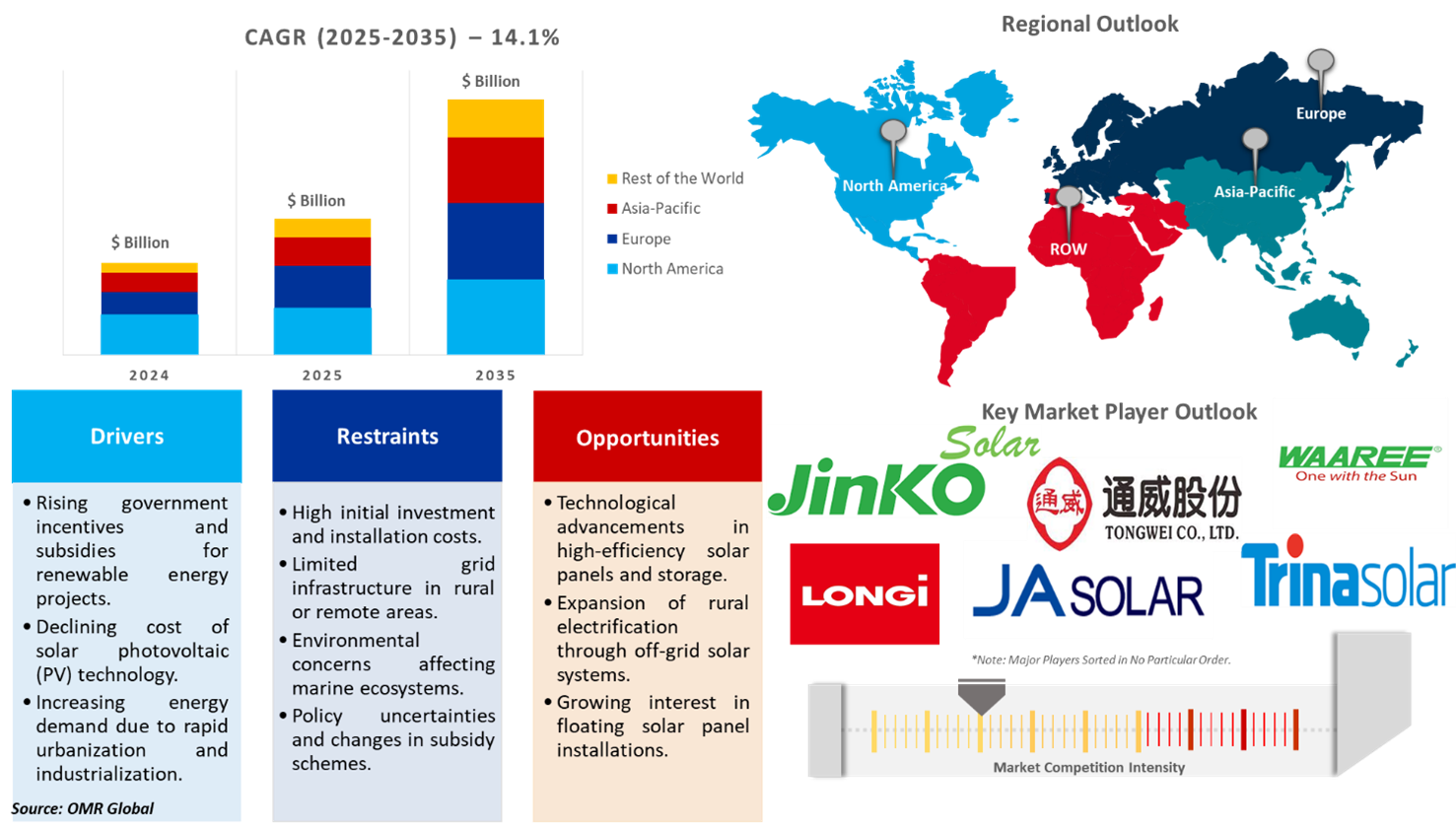
Market Dynamics
Growth in Solar and Renewable Energy Capacity
Rapid urbanization in countries such as India, China, Indonesia, and Vietnam is creating unprecedented electrical consumption. Renewable energy, particularly solar electricity, provides a scalable and sustainable option to meet this need without causing additional environmental damage. Nations such as India are making significant progress in their renewable energy program, which are critical to meeting rising electricity demand while also aligning with their energy transition goals. India’s cumulative solar power capacity stood at 119.02 GW as of July 2025. This includes 90.99 GW from ground-mounted solar plants, 19.88 GW from grid-connected rooftop systems, 3.06 GW from hybrid projects, and 5.09 GW from off-grid solar installations, reflecting the country’s diverse approach to expanding renewable energy.
- In July 2025, India’s solar power capacity had increased by 4,000%, and the country’s total renewable energy capacity reached 227 GW. Solar's versatility also contributes to further adoption, since it can be used in huge utility-scale solar farms, floating installations on reservoirs, and decentralized rooftop systems that improve energy availability in both rural and urban regions.
Market Segmentation
- Based on the panel type, the market is segmented into monocrystalline, polycrystalline, and thin-film.
- Based on the end-user, the market is segmented into residential, commercial, industrial, utility, and others.
- Based on the installation type, the market is segmented into rooftop solar installation, ground-mounted solar installation, floating solar installation, and building-integrated photovoltaics.
Monocrystalline Panels Hold the Leading Position in The Solar Panel Segment
Monocrystalline solar panels offer high efficiency (15-20%), long lifespan (over 25 years), and superb durability, ensuring a higher return on investment. The use of high-purity silicon is critical to achieve such high efficiency rates in monocrystalline solar panels. This substance is designed to be a continuous crystal structure through which electrons can travel without interruption. SunPower and LG are among the main manufacturers of high-efficiency monocrystalline panels. SunPower may be best known for its X-Series panels, which have a reported efficiency of 22.7%, among the highest available. While the slow degradation rate of monocrystalline technology attests to its enhanced sustainability and its ability to maintain its energy yield over the years, reassuring property owners and financiers equally.
Furthermore, monocrystalline solar panels have greater average temperature coefficients than polycrystalline solar panels, which means they perform better in high-temperature environments like deserts. While other solar technologies lose efficiency at high temperatures, monocrystalline panels remain exceptionally efficient in absorbing solar energy and converting it into electricity throughout the day.
Utility-Scale Solar Expansion Backed by Long-Term Agreements
The utility-scale solar segment continues to solidify its place as the major end-user category, owing to rising demand for large-scale renewable power generation and the increasing popularity of long-term power purchase agreements (PPAs) and Virtual Power Purchase Agreement (VPPA) by both companies and utilities. A ‘utility-scale’ solar project is usually defined as such if it produces 10 megawatts (MW) or more of energy. These projects not only help to meet national clean energy targets, but they additionally demonstrate how businesses are increasingly turning to utility-scale developments for reliable, low-carbon electricity. For instance, in January 2025, Vena Energy and LY Corporation (LYC) signed Japan’s largest single-unit Virtual Power Purchase Agreement (VPPA). This landmark deal centers on the 72 MW Maniwa Solar Project, which will be built on a repurposed golf course in Maniwa City, Okayama Prefecture, and is scheduled to be operational by 2026.
China Maintains a Dominant Position in the Asia Pacific Solar Panel Market
China holds a dominant position in the Asia Pacific solar panel market owing to the strong government policy support, technological advancements, increasing demand for clean energy, a well-established supply chain that spans the entire production process, and cost reductions. In 2024, clean-energy technologies contributed over 10% to China’s economic growth for the first time, driven by sales and investments totaling 13.6 trillion yuan ($1.9 trillion). Since the start of the last decade, China has invested $50 billion in new PV supply capacity, ten times more than Europe. This has resulted in the creation of over 300,000 manufacturing jobs across the PV value chain. Currently, China accounts for more than 80% of solar panel manufacturing (including polysilicon, ingots, wafers, cells, and modules). This is more than double China's proportion of global PV demand. Furthermore, the country is home to the top 10 leading suppliers of solar PV production equipment. The Chinese government has actively promoted the growth of the solar manufacturing industry. The administration pushed an industrial policy through measures such as innovation funds, exemptions from land fees and electricity bills, low-interest loans, tax credits, and grants.
India’s Growing Solar Manufacturing Capacity and Ambitious Targets
Apart from China, India has emerged as one of the fastest-growing solar energy markets across the globe. The country is rapidly expanding its solar panel manufacturing capacity in response to rising energy needs, climate commitments, and a push for energy independence. According to the Indian Ministry of New and Renewable Energy (MNRE), 36 GW of panel capacity and 16 GW of cell capacity were added during the fiscal year 2024. As of March 2025, panel and cell manufacturing capacities were 68 GW and 25 GW, respectively, more than double India's solar capacity installed in 2024. The objective is to have 120 GW of panel capacity by 2030.
Market Players Outlook
The major companies operating in the Asia Pacific solar panel market include JA SOLAR Technology Co., Ltd., JinkoSolar, LONGi Green Energy Technology Co., Ltd., Trinasolar, Tongwei Co., Ltd., among others. Market players are leveraging partnerships, collaborations, mergers, and acquisition strategies for business expansion and innovative product development to maintain their market positioning.
Recent Development
- In December 2024, Sekisui Chemical announced plans to invest in a 100 MW production line dedicated to lightweight perovskite solar panels, specifically designed for rooftops with low load-bearing capacity. Sekisui Chemical will invest JPY 90 billion ($570.64 million) in a perovskite solar production line, which is set to begin operations in 2027.
The Report Covers
- Market value data analysis of 2024 and forecast to 2035.
- Annualized market revenues ($ million) for each market segment.
- Country-wise analysis of major geographical regions.
- Key companies operating in the Asia Pacific solar panel market. Based on the availability of data, information related to new products and relevant news is also available in the report.
- Analysis of business strategies by identifying the key market segments positioned for strong growth in the future.
- Analysis of market-entry and market expansion strategies.
- Competitive strategies by identifying ‘who-stands-where’ in the market.
- Report Summary
- Current Industry Analysis and Growth Potential Outlook
- Asia-Pacific Solar Panel Market Sales Analysis – Panel Type| End-User| Installation Type ($ Million)
- Asia-Pacific Solar Panel Market Sales Performance of Top Countries
- Research Methodology
- Primary Research Approach
- Secondary Research Approach
- Market Snapshot
- Market Overview and Insights
- Scope of the Study
- Analyst Insight & Current Market Trends
- Key Asia-Pacific Solar Panel Industry Trends
- Market Recommendations
- Market Determinants
- Market Drivers
- Drivers For the Asia-Pacific Solar Panel Market: Impact Analysis
- Market Pain Points and Challenges
- Restraints For the Asia-Pacific Solar Panel Market: Impact Analysis
- Market Opportunities
- Opportunities For the Asia-Pacific Solar Panel Market: Impact Analysis
- Market Drivers
- Competitive Landscape
- Competitive Dashboard – Asia-Pacific Solar Panel Market Revenue and Share by Manufacturers
- Solar Panel Comparison Analysis
- Top Market Player Ranking Matrix
- Key Company Analysis
- JA SOLAR Technology Co., Ltd.
- Overview
- Product Portfolio
- Financial Analysis (Subject to Data Availability)
- SWOT Analysis
- Business Strategy
- JinkoSolar
- Overview
- Product Portfolio
- Financial Analysis (Subject to Data Availability)
- SWOT Analysis
- Business Strategy
- LONGi Green Energy Technology Co., Ltd.
- Overview
- Product Portfolio
- Financial Analysis (Subject to Data Availability)
- SWOT Analysis
- Business Strategy
- Trinasolar
- Overview
- Product Portfolio
- Financial Analysis (Subject to Data Availability)
- SWOT Analysis
- Business Strategy
- Tongwei Co., Ltd.
- Overview
- Product Portfolio
- Financial Analysis (Subject to Data Availability)
- SWOT Analysis
- Business Strategy Tongwei Co., Ltd.
- JA SOLAR Technology Co., Ltd.
- Key Company Analysis
- Top Winning Strategies by Market Players
- Merger and Acquisition
- Product Launch
- Partnership And Collaboration
- Asia-Pacific Solar Panel Market Sales Analysis by Panel Type ($ Million)
- Monocrystalline
- Polycrystalline
- Thin-Film
- Asia-Pacific Solar Panel Market Sales Analysis by End-User ($ Million)
- Residential
- Commercial
- Industrial
- Utility
- Others
- Asia-Pacific Solar Panel Market Sales Analysis by Installation Type ($ Million)
- Rooftop Solar Installation
- Ground-Mounted Solar Installation
- Floating Solar Installation
- Building-Integrated Photovoltaics (BIPV)
- Company Profiles
- Adani Solar
- Quick Facts
- Company Overview
- Product Portfolio
- Business Strategies
- Shanghai AIKO Energy Co., Ltd.
- Quick Facts
- Company Overview
- Product Portfolio
- Business Strategies
- Bluebird Solar
- Quick Facts
- Company Overview
- Product Portfolio
- Business Strategies
- Canadian Solar Inc
- Quick Facts
- Company Overview
- Product Portfolio
- Business Strategies
- DAS Solar Co., Ltd.
- Quick Facts
- Company Overview
- Product Portfolio
- Business Strategies
- First Solar, Inc.
- Quick Facts
- Company Overview
- Product Portfolio
- Business Strategies
- Hanwha Q CELLS
- Quick Facts
- Company Overview
- Product Portfolio
- Business Strategies
- JA SOLAR Technology Co., Ltd.
- Quick Facts
- Company Overview
- Product Portfolio
- Business Strategies
- JinkoSolar
- Quick Facts
- Company Overview
- Product Portfolio
- Business Strategies
- Loom Solar Pvt. Ltd.
- Quick Facts
- Company Overview
- Product Portfolio
- Business Strategies
- LONGi Green Energy Technology Co., Ltd.
- Quick Facts
- Company Overview
- Product Portfolio
- Business Strategies
- RenewSys India Pvt. Ltd.
- Quick Facts
- Company Overview
- Product Portfolio
- Business Strategies
- Solar Frontier K.K.
- Quick Facts
- Company Overview
- Product Portfolio
- Business Strategies
- SWELECT Energy Systems Ltd.
- Quick Facts
- Company Overview
- Product Portfolio
- Business Strategies
- Tata Power Solar Systems Ltd.
- Quick Facts
- Company Overview
- Product Portfolio
- Business Strategies
- Tongwei Co., Ltd.
- Quick Facts
- Company Overview
- Product Portfolio
- Business Strategies
- Trinasolar
- Quick Facts
- Company Overview
- Product Portfolio
- Business Strategies
- Vikram Solar Ltd.
- Quick Facts
- Company Overview
- Product Portfolio
- Business Strategies
- Waaree Energies Ltd.
- Quick Facts
- Company Overview
- Product Portfolio
- Business Strategies
- Zhejiang Chint New Energy Development Co., Ltd.
- Quick Facts
- Company Overview
- Product Portfolio
- Business Strategies
- Adani Solar
1. Asia-Pacific Solar Panel Market Research and Analysis by Panel Type, 2024–2035 ($ Million)
2. Asia-Pacific Monocrystalline Solar Panel Market Research and Analysis by Region, 2024–2035 ($ Million)
3. Asia-Pacific Polycrystalline Solar Panel Market Research and Analysis by Region, 2024–2035 ($ Million)
4. Asia-Pacific Thin-Film Solar Panel Market Research and Analysis by Region, 2024–2035 ($ Million)
5. Asia-Pacific Solar Panel Market Research and Analysis by End-User, 2024–2035 ($ Million)
6. Asia-Pacific Solar Panel for Residential Market Research and Analysis by Region, 2024–2035 ($ Million)
7. Asia-Pacific Solar Panel For Commercial Market Research and Analysis by Region, 2024–2035 ($ Million)
8. Asia-Pacific Solar Panel For Industrial Market Research and Analysis by Region, 2024–2035 ($ Million)
9. Asia-Pacific Solar Panel For Utility Market Research and Analysis by Region, 2024–2035 ($ Million)
10. Asia-Pacific Solar Panel For Other End-User Market Research and Analysis by Region, 2024–2035 ($ Million)
11. Asia-Pacific Solar Panel Market Research and Analysis by Installation Type, 2024–2035 ($ Million)
12. Asia-Pacific Rooftop Solar Installation Market Research and Analysis by Region, 2024–2035 ($ Million)
13. Asia-Pacific Ground-Mounted Solar Installation Market Research and Analysis by Region, 2024–2035 ($ Million)
14. Asia-Pacific Floating Solar Installation Market Research and Analysis by Region, 2024–2035 ($ Million)
15. Asia-Pacific Building-Integrated Photovoltaics (BIPV) Market Research and Analysis by Region, 2024–2035 ($ Million)
16. Asia-Pacific Solar Panel Market Sales Analysis by Country, 2024–2035 ($ Million)
17. China Solar Panel Market Research and Analysis by Panel Type, 2024–2035 ($ Million)
18. China Solar Panel Market Research and Analysis by End-User, 2024–2035 ($ Million)
19. China Solar Panel Market Research and Analysis by Installation Type, 2024–2035 ($ Million)
20. India Solar Panel Market Research and Analysis by Panel Type, 2024–2035 ($ Million)
21. India Solar Panel Market Research and Analysis by End-User, 2024–2035 ($ Million)
22. India Solar Panel Market Research and Analysis by Installation Type, 2024–2035 ($ Million)
23. Japan Solar Panel Market Research and Analysis by Panel Type, 2024–2035 ($ Million)
24. Japan Solar Panel Market Research and Analysis by End-User, 2024–2035 ($ Million)
25. Japan Solar Panel Market Research and Analysis by Installation Type, 2024–2035 ($ Million)
26. South Korea Solar Panel Market Research and Analysis by Panel Type, 2024–2035 ($ Million)
27. South Korea Solar Panel Market Research and Analysis by End-User, 2024–2035 ($ Million)
28. South Korea Retail Market Research and Analysis by Installation Type, 2024–2035 ($ Million)
29. Australia & New Zealand Solar Panel Market Research and Analysis by Panel Type, 2024–2035 ($ Million)
30. Australia & New Zealand Solar Panel Market Research and Analysis by End-User, 2024–2035 ($ Million)
31. Australia & New Zealand Retail Market Research and Analysis by Installation Type, 2024–2035 ($ Million)
32. ASEAN Solar Panel Market Research and Analysis by Panel Type, 2024–2035 ($ Million)
33. ASEAN Solar Panel Market Research and Analysis by End-User, 2024–2035 ($ Million)
34. ASEAN Retail Market Research and Analysis by Installation Type, 2024–2035 ($ Million)
35. Rest of Asia-Pacific Solar Panel Market Research and Analysis by Panel Type, 2024–2035 ($ Million)
36. Rest of Asia-Pacific Solar Panel Market Research and Analysis by End-User, 2024–2035 ($ Million)
37. Rest of Asia-Pacific Retail Market Research and Analysis by Installation Type, 2024–2035 ($ Million)
1. Asia-Pacific Solar Panel Market Share by Panel Type, 2024 Vs 2035 (%)
2. Asia-Pacific Monocrystalline Solar Panel Market Share by Region, 2024 Vs 2035 (%)
3. Asia-Pacific Polycrystalline Solar Panel Market Share by Region, 2024 Vs 2035 (%)
4. Asia-Pacific Thin-Film Solar Panel Market Share by Region, 2024 Vs 2035 (%)
5. Asia-Pacific Solar Panel Market Share by End-User, 2024 Vs 2035 (%)
6. Asia-Pacific Solar Panel For Residential Market Share by Region, 2024 Vs 2035 (%)
7. Asia-Pacific Solar Panel For Commercial Market Share by Region, 2024 Vs 2035 (%)
8. Asia-Pacific Solar Panel For Industrial Market Share by Region, 2024 Vs 2035 (%)
9. Asia-Pacific Solar Panel For Utility Market Share by Region, 2024 Vs 2035 (%)
10. Asia-Pacific Solar Panel For Other End-User Market Share by Region, 2024 Vs 2035 (%)
11. Asia-Pacific Solar Panel For Other Product Market Share by Country, 2024 Vs 2035 (%)
12. Asia-Pacific Solar Panel Market Share by Installation Type, 2024 Vs 2035 (%)
13. Asia-Pacific Rooftop Solar Installation Market Share by Region, 2024 Vs 2035 (%)
14. Asia-Pacific Ground-Mounted Solar Installation Market Share by Region, 2024 Vs 2035 (%)
15. Asia-Pacific Floating Solar Installation Market Share by Region, 2024 Vs 2035 (%)
16. Asia-Pacific Building-Integrated Photovoltaics (BIPV) Market Share by Region, 2024 Vs 2035 (%)
17. Asia-Pacific Solar Panel Market Share by Country, 2024 Vs 2035 (%)
18. China Solar Panel Market Size, 2024–2035 ($ Million)
19. India Solar Panel Market Size, 2024–2035 ($ Million)
20. Japan Solar Panel Market Size, 2024–2035 ($ Million)
21. South Korea Solar Panel Market Size, 2024–2035 ($ Million)
22. Australia & New Zealand Solar Panel Market Size, 2024–2035 ($ Million)
23. ASEAN Solar Panel Market Size, 2024–2035 ($ Million)
24. Rest of Asia-Pacific Solar Panel Market Size, 2024–2035 ($ Million)
- Printable version
- No restriction to number of users within the company

