China E-Fuel Market


China E-Fuel Market Size, Share & Trends Analysis Report by Fuel Type (E-Diesel, E-Gasoline, E-Hydrogen, E-Methanol, E-Ammonia, and E-Kerosene), by State of Fuel (Portable, Stationary, and Transportation (Automotive, Aviation and Marine)), and by Application (Liquid Fuel and Gas Fuel), Forecast Period (2025-2035)
Industry Overview
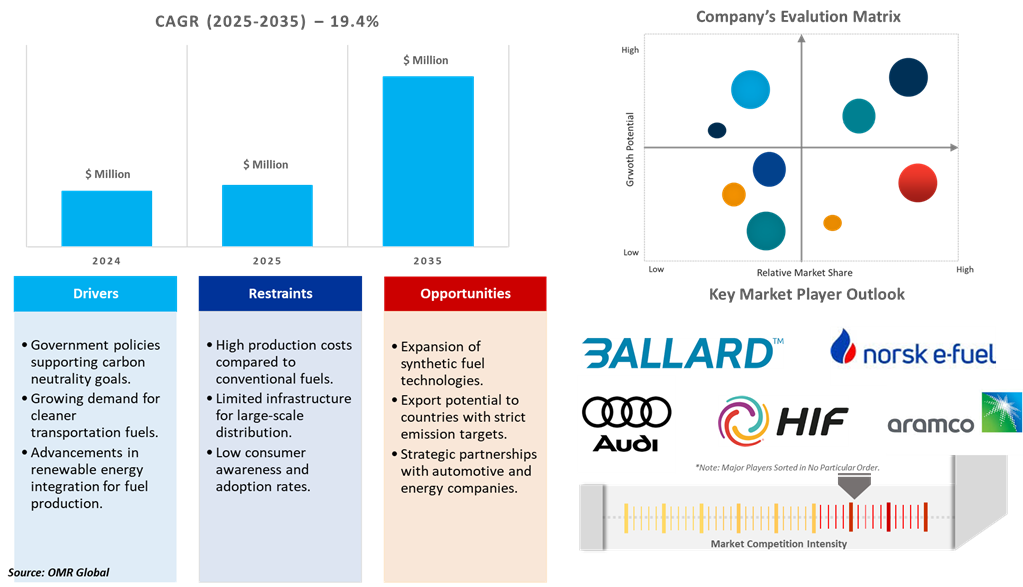
China E-fuel market was valued at $10.5 billion in 2024 and is projected to reach $87.1 billion by 2035, growing at a CAGR of 19.4% during the forecast period (2025–2035). The Chinese market for e-fuels is evolving with efficiencies in manufacturing, providing increasing cost reductions and quality outputs. Pilot programs are demonstrating more successful viability at scale in urban and rural locations. There are many collaborative working models between research facilities and industry players, with a lot of innovation for different fuel developmental forms and simultaneous storage solutions. Projects targeting export markets are building pathways for Chinese manufacturers to access global markets.
- In October 2024, China Energy Engineering and China Electric Power Engineering Consulting Group began building the Shuangyashan Green Methanol and Aviation Fuel Demonstration Base in Heilongjiang. Combining wind, solar, hydrogen, and biomass, the project will produce 200,000 tons of green methanol and 300,000 tons of green aviation fuel annually. Phase one, costing 6 billion yuan ($857 million), will generate 100,000 tons of green aviation fuel per year and includes a 450 MW wind farm, solar plant, hydrogen station, biomass facility, and synthesis plant, with operations starting in 2027.
Market Dynamics
Expansion of Sustainable Aviation Fuel Projects
China's e-fuel market is growing rapidly for sustainable aviation fuel programs, with there being quite a few major projects being announced for both domestic and international demand. For instance, Shanxi International Energy Group is investing heavily in Inner Mongolia to produce e-kerosene from hydrogen (wind-powered) and sequestered CO?. This enhances the global aviation decarbonization target, making the company a competitive producer and exporter in the Asia Pacific region. These projects diversify China's clean fuel mix and enhance export potential.
Advancement in Waste-to-Fuel Technologies
The conversion of waste into high-quality e-fuels is emerging as an interesting opportunity in China's clean energy plan. For instance, SINOPEC partnered with TotalEnergies to construct a production facility that converts used cooking oils and animal fats into sustainable aviation fuel. This illustrates the circular economy for a financially viable energy solution that is environmentally friendly. Utilization of waste-based feedstocks in e-fuel manufacturing is expected to reduce lifecycle greenhouse gas emissions and overall resource efficiency.
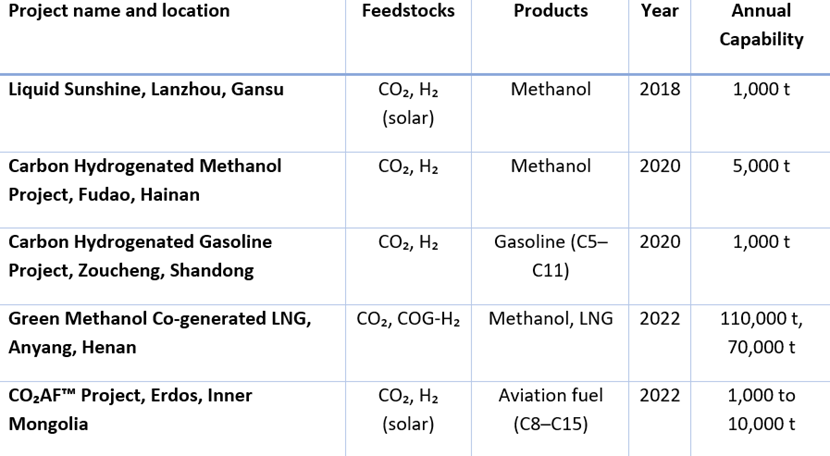
Overview of Demonstration and Pilot-Scale E-Fuel Projects in China
Market Segmentation
- Based on the fuel type, the market is segmented into e-diesel, e-gasoline, e-hydrogen, e-methanol, e-ammonia, and e-kerosene.
- Based on the application, the market is segmented into portable, stationary, and transportation.
- Based on the state of fuel, the market is segmented into liquid fuel and gas fuel.
Transportation: A Key Segment in Market Growth
The transportation sector is a primary impetus for e-fuel adoption in China, spurred by the need to decarbonize passenger and freight mobility. For instance, Shanxi International Energy Group's investment in the production of e-kerosene is a step toward providing alternatives in aviation that are low-carbon. This is complemented by pilot programs to incorporate e-fuels into commercial fleets of vehicles in urban centers. Expanded infrastructure for fueling is also improving end-user access in modes of transport. Strategic partnerships between auto industry players and energy producers are increasing market readiness.
Market Players Outlook
The major companies operating in the China e-fuel market include Aramco (Saudi Arabian Oil Company), Audi AG, Ballard Power Systems, HIF Global, and Norsk e-Fuel, among others. Market players are leveraging partnerships, collaborations, mergers, and acquisition strategies for business expansion and innovative product development to maintain their market positioning.
Recent Developments
- In September 2024, China's government launched a sustainable aviation fuel (SAF) program in a number of airports to support a green and low-carbon transformation in the aviation industry. SAF is a liquid aviation fuel replacement for regular jet fuel. Produced from renewable resources, it can lower carbon emissions by up to 80.0% during the life cycle of the fuel from that of regular jet fuel.
- In January 2024, Geely Auto is promoting methanol as a scalable e-fuel, as large fleets in select Chinese cities are already running methanol-powered vehicles. This is an interesting avenue since these applications utilize carbon dioxide from bulky emissions from heavy industry to create cleaner-burning fuels. By contrast, the previous generation non-hybrid Geely Emgrand M100, Geely’s methanol-powered passenger car, emits just 46 grams per kilometer of CO2 from well to wheel.
The Report Covers
- Market value data analysis of 2024 and forecast to 2035.
- Annualized market revenues ($ million) for each market segment.
- Country-wise analysis of major geographical regions.
- Key companies operating in the China e-fuel market. Based on the availability of data, information related to new products and relevant news is also available in the report.
- Analysis of business strategies by identifying the key market segments positioned for strong growth in the future.
- Analysis of market-entry and market expansion strategies.
- Competitive strategies by identifying ‘who-stands-where’ in the market.
1. Report Summary
• Current Industry Analysis and Growth Potential Outlook
• China E-Fuel Market Sales Analysis – Fuel Type | Application | State of Fuel ($ Million)
1.1. Research Methodology
• Primary Research Approach
• Secondary Research Approach
1.2. Market Snapshot
2. Market Overview and Insights
2.1. Scope of the Study
2.2. Analyst Insight & Current Market Trends
2.2.1. Key China E-Fuel Industry Trends
2.2.2. Market Recommendations
3. Market Determinants
3.1. Market Drivers
3.1.1. Drivers For the China E-Fuel Market: Impact Analysis
3.2. Market Pain Points and Challenges
3.2.1. Restraints For the China E-Fuel Market: Impact Analysis
3.3. Market Opportunities
3.3.1. Opportunities For the China E-Fuel Market: Impact Analysis
4. Competitive Landscape
4.1. Competitive Dashboard – China E-Fuel Market Revenue and Share by Manufacturers
• E-Fuel Product Comparison Analysis
• Top Market Player Ranking Matrix
4.2. Key Company Analysis
4.2.1. Aramco (Saudi Arabian Oil Company)
4.2.1.1. Overview
4.2.1.2. Product Portfolio
4.2.1.3. Financial Analysis (Subject to Data Availability)
4.2.1.4. SWOT Analysis
4.2.1.5. Business Strategy
4.2.2. Audi AG
4.2.2.1. Overview
4.2.2.2. Product Portfolio
4.2.2.3. Financial Analysis (Subject to Data Availability)
4.2.2.4. SWOT Analysis
4.2.2.5. Business Strategy
4.2.3. Ballard Power Systems
4.2.3.1. Overview
4.2.3.2. Product Portfolio
4.2.3.3. Financial Analysis (Subject to Data Availability)
4.2.3.4. SWOT Analysis
4.2.3.5. Business Strategy
4.2.4. HIF Global
4.2.4.1. Overview
4.2.4.2. Product Portfolio
4.2.4.3. Financial Analysis (Subject to Data Availability)
4.2.4.4. SWOT Analysis
4.2.4.5. Business Strategy
4.2.5. Norsk e-Fuel
4.2.5.1. Overview
4.2.5.2. Product Portfolio
4.2.5.3. Financial Analysis (Subject to Data Availability)
4.2.5.4. SWOT Analysis
4.2.5.5. Business Strategy
4.3. Top Winning Strategies by Market Players
4.3.1. Merger and Acquisition
4.3.2. Product Launch
4.3.3. Partnership And Collaboration
5. China E-Fuel Market Sales Analysis by Fuel Type ($ Million)
5.1. E-Diesel
5.2. E-Gasoline
5.3. E-Hydrogen
5.4. E-Methanol
5.5. E-Ammonia
5.6. E-Kerosene
6. China E-Fuel Market Sales Analysis by Application ($ Million)
6.1. Portable
6.2. Stationary
6.3. Transportation
6.3.1. Automotive
6.3.2. Marine
6.3.3. Aviation
7. China E-Fuel Market Sales Analysis by State of Fuel ($ Million)
7.1. Liquid Fuel (Power to Liquid)
7.2. Gas Fuel (Power to Gas)
8. Company Profiles
8.1. Aramco
8.1.1. Quick Facts
8.1.2. Company Overview
8.1.3. Product Portfolio
8.1.4. Business Strategies
8.2. Air Liquide
8.2.1. Quick Facts
8.2.2. Company Overview
8.2.3. Product Portfolio
8.2.4. Business Strategies
8.3. ANDRITZ
8.3.1. Quick Facts
8.3.2. Company Overview
8.3.3. Product Portfolio
8.3.4. Business Strategies
8.4. Arcadia eFuels
8.4.1. Quick Facts
8.4.2. Company Overview
8.4.3. Product Portfolio
8.4.4. Business Strategies
8.5. Atmosfair
8.5.1. Quick Facts
8.5.2. Company Overview
8.5.3. Product Portfolio
8.5.4. Business Strategies
8.6. Audi AG
8.6.1. Quick Facts
8.6.2. Company Overview
8.6.3. Product Portfolio
8.6.4. Business Strategies
8.7. Ballard Power Systems
8.7.1. Quick Facts
8.7.2. Company Overview
8.7.3. Product Portfolio
8.7.4. Business Strategies
8.8. Beijing Hydrogen E Energy Science & Technology Co., Ltd.
8.8.1. Quick Facts
8.8.2. Company Overview
8.8.3. Product Portfolio
8.8.4. Business Strategies
8.9. CEMEX
8.9.1. Quick Facts
8.9.2. Company Overview
8.9.3. Product Portfolio
8.9.4. Business Strategies
8.10. Chiyoda Corporation
8.10.1. Quick Facts
8.10.2. Company Overview
8.10.3. Product Portfolio
8.10.4. Business Strategies
8.11. ClimaHtech
8.11.1. Quick Facts
8.11.2. Company Overview
8.11.3. Product Portfolio
8.11.4. Business Strategies
8.12. Climeworks
8.12.1. Quick Facts
8.12.2. Company Overview
8.12.3. Product Portfolio
8.12.4. Business Strategies
8.13. ecoFT (Sasol Group)
8.13.1. Quick Facts
8.13.2. Company Overview
8.13.3. Product Portfolio
8.13.4. Business Strategies
8.14. Electric Hydrogen
8.14.1. Quick Facts
8.14.2. Company Overview
8.14.3. Product Portfolio
8.14.4. Business Strategies
8.15. Electrochaea
8.15.1. Quick Facts
8.15.2. Company Overview
8.15.3. Product Portfolio
8.15.4. Business Strategies
8.16. ENEOS Holdings
8.16.1. Quick Facts
8.16.2. Company Overview
8.16.3. Product Portfolio
8.16.4. Business Strategies
8.17. ENERTRAG
8.17.1. Quick Facts
8.17.2. Company Overview
8.17.3. Product Portfolio
8.17.4. Business Strategies
8.18. ExxonMobil
8.18.1. Quick Facts
8.18.2. Company Overview
8.18.3. Product Portfolio
8.18.4. Business Strategies
8.19. FuelCell Energy
8.19.1. Quick Facts
8.19.2. Company Overview
8.19.3. Product Portfolio
8.19.4. Business Strategies
8.20. HIF Global
8.20.1. Quick Facts
8.20.2. Company Overview
8.20.3. Product Portfolio
8.20.4. Business Strategies
8.21. INERATEC
8.21.1. Quick Facts
8.21.2. Company Overview
8.21.3. Product Portfolio
8.21.4. Business Strategies
8.22. Infinium
8.22.1. Quick Facts
8.22.2. Company Overview
8.22.3. Product Portfolio
8.22.4. Business Strategies
8.23. ITM Power
8.23.1. Quick Facts
8.23.2. Company Overview
8.23.3. Product Portfolio
8.23.4. Business Strategies
8.24. Liquid Wind
8.24.1. Quick Facts
8.24.2. Company Overview
8.24.3. Product Portfolio
8.24.4. Business Strategies
8.25. NEL ASA
8.25.1. Quick Facts
8.25.2. Company Overview
8.25.3. Product Portfolio
8.25.4. Business Strategies
8.26. Norsk e-Fuel
8.26.1. Quick Facts
8.26.2. Company Overview
8.26.3. Product Portfolio
8.26.4. Business Strategies
8.27. Plug Power
8.27.1. Quick Facts
8.27.2. Company Overview
8.27.3. Product Portfolio
8.27.4. Business Strategies
8.28. Porsche
8.28.1. Quick Facts
8.28.2. Company Overview
8.28.3. Product Portfolio
8.28.4. Business Strategies
8.29. Repsol, S.A.
8.29.1. Quick Facts
8.29.2. Company Overview
8.29.3. Product Portfolio
8.29.4. Business Strategies
8.30. Siemens Energy
8.30.1. Quick Facts
8.30.2. Company Overview
8.30.3. Product Portfolio
8.30.4. Business Strategies
8.31. Spark e-Fuels
8.31.1. Quick Facts
8.31.2. Company Overview
8.31.3. Product Portfolio
8.31.4. Business Strategies
8.32. StormFisher Hydrogen
8.32.1. Quick Facts
8.32.2. Company Overview
8.32.3. Product Portfolio
8.32.4. Business Strategies
8.33. Sunfire
8.33.1. Quick Facts
8.33.2. Company Overview
8.33.3. Product Portfolio
8.33.4. Business Strategies
8.34. Synhelion
8.34.1. Quick Facts
8.34.2. Company Overview
8.34.3. Product Portfolio
8.34.4. Business Strategies
8.35. Uniper SE
8.35.1. Quick Facts
8.35.2. Company Overview
8.35.3. Product Portfolio
8.35.4. Business Strategies
8.36. Yara International
8.36.1. Quick Facts
8.36.2. Company Overview
8.36.3. Product Portfolio
8.36.4. Business Strategies
1. China E-Fuel Market Research and Analysis by Fuel Type, 2024–2035 ($ Million)
2. China E-Diesel Market Research and Analysis, 2024–2035 ($ Million)
3. China E-Gasoline Market Research and Analysis, 2024–2035 ($ Million)
4. China E-Hydrogen Market Research and Analysis, 2024–2035 ($ Million)
5. China E-Methanol Market Research and Analysis, 2024–2035 ($ Million)
6. China E-Ammonia Market Research and Analysis, 2024–2035 ($ Million)
7. China E-Kerosene Market Research and Analysis, 2024–2035 ($ Million)
8. China E-Fuel Market Research and Analysis by Application, 2024–2035 ($ Million)
9. China E-Fuel For Portable Market Research and Analysis, 2024–2035 ($ Million)
10. China E-Fuel For Stationary Market Research and Analysis, 2024–2035 ($ Million)
11. China E-Fuel For Transportation Market Research and Analysis, 2024–2035 ($ Million)
12. China E-Fuel For Automotive Market Research and Analysis, 2024–2035 ($ Million)
13. China E-Fuel For Marine Market Research and Analysis, 2024–2035 ($ Million)
14. China E-Fuel For Aviation Market Research and Analysis, 2024–2035 ($ Million)
15. China E-Fuel Market Research and Analysis by State of Fuel, 2024–2035 ($ Million)
16. China Liquid E-Fuel Market Research and Analysis, 2024–2035 ($ Million)
17. China Gas E-Fuel Market Research and Analysis, 2024–2035 ($ Million)
1. China E-Fuel Market Share by Fuel Type, 2024 Vs 2035 (%)
2. China E-Diesel Market Research and Analysis, 2024 Vs 2035 (%)
3. China E-Gasoline Market Research and Analysis, 2024 Vs 2035 (%)
4. China E-Hydrogen Market Research and Analysis, 2024 Vs 2035 (%)
5. China E-Methanol Market Research and Analysis, 2024 Vs 2035 (%)
6. China E-Ammonia Market Research and Analysis, 2024 Vs 2035 (%)
7. China E-Kerosene Market Research and Analysis, 2024 Vs 2035 (%)
8. China E-Fuel Market Share by Application, 2024 Vs 2035 (%)
9. China E-Fuel For Portable Market Share, 2024 Vs 2035 (%)
10. China E-Fuel For Stationary Market Share, 2024 Vs 2035 (%)
11. China E-Fuel For Transportation Market Share, 2024 Vs 2035 (%)
12. China E-Fuel For Automotive Market Share, 2024 Vs 2035 (%)
13. China E-Fuel For Marine Market Share, 2024 Vs 2035 (%)
14. China E-Fuel For Aviation Market Share, 2024 Vs 2035 (%)
15. China E-Fuel Market Share by State of Fuel, 2024 Vs 2035 (%)
16. China Liquid E-Fuel Market Share, 2024 Vs 2035 (%)
17. China Gas E-Fuel Market Share, 2024 Vs 2035 (%)
- Printable version
- No restriction to number of users within the company