Corporate Wellness Software Market


Corporate Wellness Software Market Size, Share & Trends Analysis Report by Solution Type (Health Risk Assessment, Fitness & Activity Tracking, Mental Wellbeing Management, Nutrition & Diet Management, Employee Engagement & Incentive Management, and Others), by Deployment Type (On-Premises, and Cloud-Based), by End User (Large Enterprises, Small and Medium Enterprises (SMEs)), and by Licensing Model (Subscription, and Perpetual License), Forecast Period (2026-2035)
Industry Overview
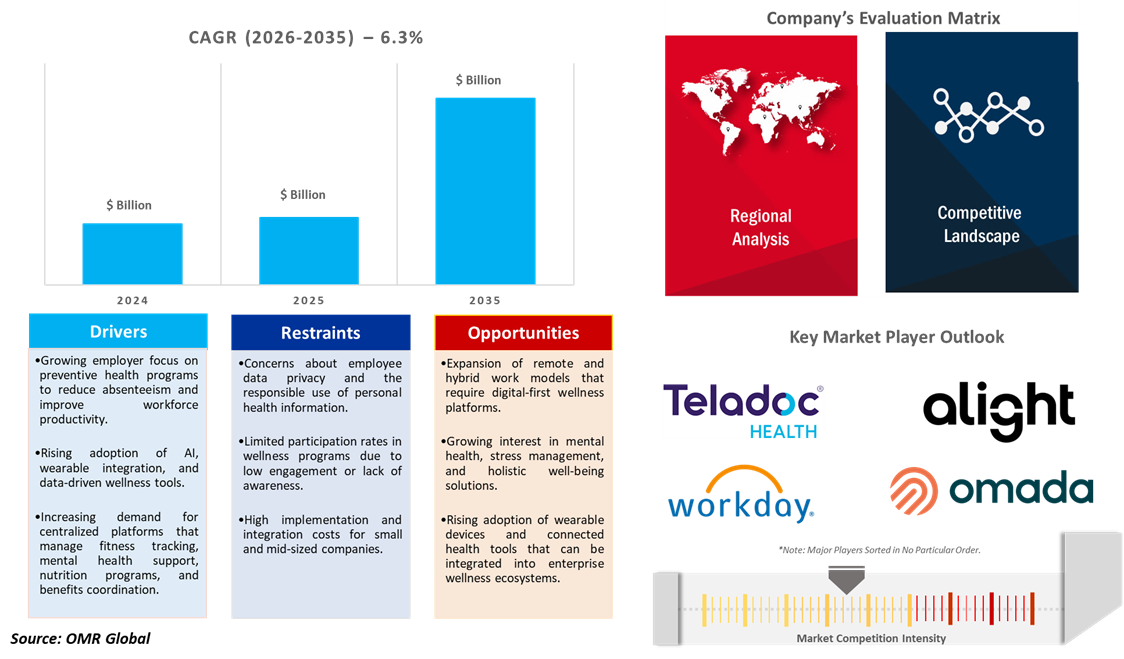
Corporate wellness software market was valued at $1.7 billion in 2025 and is projected to reach $3.1 billion by 2035, growing at a CAGR of 6.3% during the forecast period (2026–2035). Companies are increasing their focus on employee well-being as a way to manage rising healthcare expenses and support stronger workforce productivity. As a result, more organizations are putting structured wellness programs in place, which is driving the use of corporate wellness software.
Awareness of employee health continues to grow, and firms across many industries are adopting tools that help workers maintain better physical and mental health. These programs support healthier lifestyles, improve performance, and help reduce overall operating costs. Employers are turning to platforms that combine fitness tracking, mental health support, nutrition planning, and engagement features in a single system. The pressure to control healthcare spending is a major factor behind this shift. For instance, the International Foundation of Employee Benefit Plans (IFEBP) reports that US employers expect a median 7% rise in healthcare costs in 2024. Additionally, Aon estimates that average employer healthcare expenses will increase by 8.5%, reaching more than $15,000 per employee.
Market Dynamics
The Shift to Hybrid and Remote Work Is Fueling Demand for Corporate Wellness Platforms
Organizations are increasingly relying on digital wellness platforms as they manage hybrid and remote workforces, which is a major factor propelling the corporate wellness software market. As more employees split their time between home and office, companies are turning to virtual wellness tools to maintain engagement, reduce stress, and support work-life balance.
Technology is shaping this shift. Employers are deploying apps and online portals that offer mental health resources, fitness tracking, and wellness coaching to employees wherever they work. For instance, CloudFit, an AI-based wellness platform, provides personalized fitness, nutrition, and sleep programs that adjust to a user’s home or remote environment. It is being used by organizations such as Howden Insurance to support distributed teams, highlighting how digital wellness solutions are becoming essential for hybrid workplaces.
Rising Absenteeism and Productivity Loss Remain a Major Factor Driving the Adoption of Corporate Wellness Software
Corporations are adopting wellness software to address rising absenteeism and improve productivity, which has become a major factor driving the market. Wellness programs act as preventative measures by encouraging healthy habits and lowering the number of sick days linked to physical and mental health issues. As a result, employers are investing in corporate wellness software to manage healthcare costs and maintain steady workforce performance.
Absenteeism remains a challenge across many workplaces, as high absence rates disrupt operations, strain resources, and weaken overall productivity. For instance, the 23rd annual CIPD Health and Wellbeing at Work report recorded an average of 7.8 sick days per employee, the highest level in more than a decade and a sharp rise from the pre-pandemic rate of 5.8 days. Frequent absences often point to deeper concerns, such as low engagement or stress-related conditions. Wellness programs help address these issues by offering mental health support, fitness activities, lifestyle coaching, and other preventative tools. The aim is to keep employees healthy, reduce stress, and prevent burnout, which helps lower sick leave and improve attendance. For instance, companies using Virgin Pulse saw meaningful annual indirect cost savings of 8-15% fewer work absences, 10-25% less turnover, and a 5-10% reduction in workers' compensation.
Market Segmentation
- Based on the solution type, the market is segmented into health risk assessment, fitness & activity tracking, mental wellbeing management, nutrition & diet management, employee engagement & incentive management, and others.
- Based on the deployment type, the market is segmented into on-premises, and cloud-based.
- Based on the end user, the market is segmented into large enterprises, and small and medium enterprises (SMEs).
- Based on the licensing model, the market is segmented into subscription, and perpetual license.
Growing Adoption of Mental Wellbeing Management Solutions
Based on solution type, mental well-being management is expanding quickly as firms prioritize stress reduction, burnout prevention, and behavioral health support. Mental health concerns have become more visible in the workplace, and employers are recognizing the operational impact of unresolved stress, anxiety, and burnout. According to Mind Share Partners, half of US workers experience moderate to severe burnout, depression, or anxiety, and nearly 90% report at least minor mental health challenges, the highest level since 2019. This growing pressure is encouraging companies to adopt corporate wellness platforms that include targeted mental health features.
Organizations are investing in tools that support emotional well-being because they help maintain productivity and strengthen workforce stability. Modern platforms now offer stress management resources, meditation modules, virtual therapy access, and mood tracking to help employees manage daily pressures. The increased focus on employee mental and physical health is driving broader use of wellness software across industries, positioning mental well-being management as one of the fastest-growing segments in the market.
Fitness and Activity Tracking Dominates as a Key Market Segment
Fitness and activity tracking hold a large share of the corporate wellness software market because it is widely adopted across industries. Employers are looking for tools that encourage regular movement and support healthier routines at work, especially as they manage a mix of hybrid and in-office employees. Companies are increasingly adopting platforms that combine activity monitoring with social interaction and incentives, creating steady engagement and helping employees stay active throughout the day. This shift is reflected in recent platform developments. For instance, in November 2025, Motivosity launched a new Wellness Module co-developed with Sworkit Health. This integration enhances employee engagement by combining wellness initiatives with existing rewards programs, promoting well-being as a daily, social part of company culture. Motivosity's new Wellness Module offers an all-in-one platform combining wellness challenges, recognition, rewards, and communication, simplifying HR processes. It features automated wellness tracking via Apple Health, Fitbit, and Google Fit integration.
Regional Outlook
The global corporate wellness software market is further divided by region, including North America (the US and Canada), Europe (the UK, Germany, France, Italy, Spain, Russia, and the Rest of Europe), Asia-Pacific (India, China, Japan, South Korea, Australia and New Zealand, ASEAN Countries, and the Rest of Asia-Pacific), and the Rest of the World (the Middle East & Africa, and Latin America).
North America Leads the Global Corporate Wellness Software Market Growth
North America dominates the global corporate wellness software market, driven by high corporate investment in employee wellbeing and uptake of digital health solutions. Employers in the region are increasingly treating wellness not as a perk, but as a strategic tool to manage chronic disease risks, mental health issues, and other costs associated with an aging or stressed workforce.
Recent initiatives from organizations in the region illustrate this momentum. For instance, HRG North America partnered with CoreHealth Technologies to run a six-week “Around the World” step challenge for its US workforce. The program used CoreHealth’s corporate wellness platform to track activity, promote daily movement, and engage employees through a structured fitness challenge.
Market Players Outlook
The major companies operating in the global corporate wellness software market include Alight Solutions LLC, Omada Health, Inc., Teladoc Health, Inc., Workday, Inc., among others. Market players are leveraging partnerships, collaborations, mergers, and acquisition strategies for business expansion and innovative product development to maintain their market positioning.
Recent Developments
- In September 2025, BetterMe launched BetterMe Business, an employee wellness program providing holistic tools to support physical and mental well-being. It offers resources to inspire movement, recovery, and productivity. The app features accessibility for diverse teams, engaging challenges, a streamlined HR workspace with management and analytics, Zoom integration, and on-demand coaching to enhance connections, reduce stress, and boost organizational productivity.
- In November 2024, SBC Medical Group Holdings launched SBC Wellness, a corporate wellness solution aimed at enhancing employee benefits. Targeting HR managers, the program seeks to improve recruitment, retention, and employee well-being. SBC Wellness starts with a VIP concierge consultation via app or phone to address user concerns and guide treatment options. It offers clinic recommendations, appointment scheduling, and price checks with promotions.
- Virgin Pulse and HealthComp merged in November 2023 and launched a new brand, Personify Health, on February 7, 2024. Personify Health offers the first personalized health platform combining health plan administration, holistic wellbeing solutions, and comprehensive health navigation in one place.
The Report Covers
- Market value data analysis of 2025 and forecast to 2035.
- Annualized market revenues ($ million) for each market segment.
- Country-wise analysis of major geographical regions.
- Key companies operating in the global corporate wellness software market. Based on the availability of data, information related to new products and relevant news is also available in the report.
- Analysis of business strategies by identifying the key market segments positioned for strong growth in the future.
- Analysis of market-entry and market expansion strategies.
- Competitive strategies by identifying ‘who-stands-where’ in the market.
- Report Summary
- Current Industry Analysis and Growth Potential Outlook
- Global Corporate Wellness Software Market Sales Analysis – Solution Type| Deployment Type| End User| Licensing Model ($ Million)
- Corporate Wellness Software Market Sales Performance of Top Countries
- Research Methodology
- Primary Research Approach
- Secondary Research Approach
- Market Snapshot
- Market Overview and Insights
- Scope of the Study
- Analyst Insight & Current Market Trends
- Key Corporate Wellness Software Industry Trends
- Market Recommendations
- Market Determinants
- Market Drivers
- Drivers For Global Corporate Wellness Software Market: Impact Analysis
- Market Pain Points and Challenges
- Restraints For Global Corporate Wellness Software Market: Impact Analysis
- Market Opportunities
- Opportunities For Global Corporate Wellness Software Market: Impact Analysis
- Market Drivers
- Competitive Landscape
- Competitive Dashboard – Corporate Wellness Software Market Revenue and Share by Manufacturers
- Corporate Wellness Software Product Comparison Analysis
- Top Market Player Ranking Matrix
- Key Company Analysis
- Alight Solutions LLC
- Overview
- Product Portfolio
- Financial Analysis
- SWOT Analysis
- Business Strategy
- Omada Health, Inc.
- Overview
- Product Portfolio
- Financial Analysis
- SWOT Analysis
- Business Strategy
- Teladoc Health, Inc.
- Overview
- Product Portfolio
- Financial Analysis
- SWOT Analysis
- Business Strategy
- Workday, Inc.
- Overview
- Product Portfolio
- Financial Analysis
- SWOT Analysis
- Business Strategy
- Top Winning Strategies by Market Players
- Merger and Acquisition
- Product Launch
- Partnership And Collaboration
- Alight Solutions LLC
- Key Company Analysis
- Global Corporate Wellness Software Market Sales Analysis by Solution Type ($ Million)
- Health Risk Assessment
- Fitness & Activity Tracking
- Mental Wellbeing Management
- Nutrition & Diet Management
- Employee Engagement & Incentive Management
- Others (Telehealth Integration, Remote Health Monitoring, Reporting & Analytics)
- Global Corporate Wellness Software Market Sales Analysis by Deployment Type ($ Million)
- On-Premises
- Cloud-Based
- Global Corporate Wellness Software Market Sales Analysis by End User ($ Million)
- Large Enterprises
- Small and Medium Enterprises (SMEs)
- Global Corporate Wellness Software Market Sales Analysis by Licensing Model ($ Million)
- Subscription
- Perpetual License
- Regional Analysis
- North American Corporate Wellness Software Market Sales Analysis – Solution Type| Deployment Type| End User| Licensing Model | Country ($ Million)
- Macroeconomic Factors for North America
- United States
- Canada
- European Corporate Wellness Software Market Sales Analysis – Solution Type| Deployment Type| End User| Licensing Model | Country ($ Million)
- Macroeconomic Factors for Europe
- UK
- Germany
- Italy
- Spain
- France
- Russia
- Rest of Europe
- Asia-Pacific Corporate Wellness Software Market Sales Analysis – Solution Type| Deployment Type| End User| Licensing Model | Country ($ Million)
- Macroeconomic Factors for Asia-Pacific
- China
- Japan
- South Korea
- India
- Australia & New Zealand
- ASEAN Countries (Thailand, Indonesia, Vietnam, Singapore, And Other)
- Rest of Asia-Pacific
- Rest of the World Corporate Wellness Software Market Sales Analysis – Solution Type| Deployment Type| End User| Licensing Model | Country ($ Million)
- Macroeconomic Factors for Rest of the World
- Latin America
- Middle East and Africa
- Company Profiles
- Alight Solutions LLC
- Quick Facts
- Company Overview
- Product Portfolio
- Business Strategies
- Athletes’ Performance, Inc. (Exos)
- Quick Facts
- Company Overview
- Product Portfolio
- Business Strategies
- Bargain Technologies Private Ltd. (VantageFit)
- Quick Facts
- Company Overview
- Product Portfolio
- Business Strategies
- BetterMe International Ltd.
- Quick Facts
- Company Overview
- Product Portfolio
- Business Strategies
- Burnalong, Inc.
- Quick Facts
- Company Overview
- Product Portfolio
- Business Strategies
- Calm
- Quick Facts
- Company Overview
- Product Portfolio
- Business Strategies
- Castlight Health, Inc.
- Quick Facts
- Company Overview
- Product Portfolio
- Business Strategies
- ComPsych Corp.
- Quick Facts
- Company Overview
- Product Portfolio
- Business Strategies
- Corehealth Technologies Inc.
- Quick Facts
- Company Overview
- Product Portfolio
- Business Strategies
- Fitbit International Ltd.
- Quick Facts
- Company Overview
- Product Portfolio
- Business Strategies
- Headspace Inc.
- Quick Facts
- Company Overview
- Product Portfolio
- Business Strategies
- HealthifyMe
- Quick Facts
- Company Overview
- Product Portfolio
- Business Strategies
- Laboratory Corporation of America Holdings
- Quick Facts
- Company Overview
- Product Portfolio
- Business Strategies
- Limeade, Inc.
- Quick Facts
- Company Overview
- Product Portfolio
- Business Strategies
- Omada Health, Inc.
- Quick Facts
- Company Overview
- Product Portfolio
- Business Strategies
- Personify Health, Inc.
- Quick Facts
- Company Overview
- Product Portfolio
- Business Strategies
- Sharecare, Inc.
- Quick Facts
- Company Overview
- Product Portfolio
- Business Strategies
- SpotMe Fitness Company (IncentFit)
- Quick Facts
- Company Overview
- Product Portfolio
- Business Strategies
- Teladoc Health, Inc.
- Quick Facts
- Company Overview
- Product Portfolio
- Business Strategies
- Terryberry Company, LLC
- Quick Facts
- Company Overview
- Product Portfolio
- Business Strategies
- Vantage Circle
- Quick Facts
- Company Overview
- Product Portfolio
- Business Strategies
- Vitality Group, LLC
- Quick Facts
- Company Overview
- Product Portfolio
- Business Strategies
- Wellable, LLC
- Quick Facts
- Company Overview
- Product Portfolio
- Business Strategies
- Wellness 360 Technologies, Inc.
- Quick Facts
- Company Overview
- Product Portfolio
- Business Strategies
- WellRight, Inc.
- Quick Facts
- Company Overview
- Product Portfolio
- Business Strategies
- WellSteps, LLC.
- Quick Facts
- Company Overview
- Product Portfolio
- Business Strategies
- Workday, Inc.
- Quick Facts
- Company Overview
- Product Portfolio
- Business Strategies
- yuMuuv OÜ
- Quick Facts
- Company Overview
- Product Portfolio
- Business Strategies
- Alight Solutions LLC
1. Global Corporate Wellness Software Market Research and Analysis by Solution Type, 2025–2035 ($ Million)
2. Global Corporate Wellness Software for Health Risk Assessment Market Research and Analysis by Region, 2025–2035 ($ Million)
3. Global Corporate Wellness Software for Fitness and Activity Tracking Market Research and Analysis by Region, 2025–2035 ($ Million)
4. Global Corporate Wellness Software for Mental Wellbeing Management Market Research and Analysis by Region, 2025–2035 ($ Million)
5. Global Corporate Wellness Software for Nutrition and Diet Management Market Research and Analysis by Region, 2025–2035 ($ Million)
6. Global Corporate Wellness Software for Employee Engagement and Incentive Management Market Research and Analysis by Region, 2025–2035 ($ Million)
7. Global Other Corporate Wellness Software Market Research and Analysis by Region, 2025–2035 ($ Million)
8. Global Corporate Wellness Software Market Research and Analysis by Deployment Type, 2025–2035 ($ Million)
9. Global On Premises Corporate Wellness Software Market Research and Analysis by Region, 2025–2035 ($ Million)
10. Global Cloud Based Corporate Wellness Software Market Research and Analysis by Region, 2025–2035 ($ Million)
11. Global Corporate Wellness Software Market Research and Analysis by End User, 2025–2035 ($ Million)
12. Global Corporate Wellness Software for Large Enterprises Market Research and Analysis by Region, 2025–2035 ($ Million)
13. Global Corporate Wellness Software for Small and Medium Enterprises Market Research and Analysis by Region, 2025–2035 ($ Million)
14. Global Corporate Wellness Software Market Research and Analysis by Licensing Model, 2025–2035 ($ Million)
15. Global Subscription Based Corporate Wellness Software Market Research and Analysis by Region, 2025–2035 ($ Million)
16. Global Perpetual License Based Corporate Wellness Software Market Research and Analysis by Region, 2025–2035 ($ Million)
17. Global Corporate Wellness Software Market Research and Analysis by Region, 2025–2035 ($ Million)
18. North American Corporate Wellness Software Market Research and Analysis by Country, 2025–2035 ($ Million)
19. North American Corporate Wellness Software Market Research and Analysis by Solution Type, 2025–2035 ($ Million)
20. North American Corporate Wellness Software Market Research and Analysis by Deployment Type, 2025–2035 ($ Million)
21. North American Corporate Wellness Software Market Research and Analysis by End User, 2025–2035 ($ Million)
22. North American Corporate Wellness Software Market Research and Analysis by Licensing Model, 2025–2035 ($ Million)
23. European Corporate Wellness Software Market Research and Analysis by Country, 2025–2035 ($ Million)
24. European Corporate Wellness Software Market Research and Analysis by Solution Type, 2025–2035 ($ Million)
25. European Corporate Wellness Software Market Research and Analysis by Deployment Type, 2025–2035 ($ Million)
26. European Corporate Wellness Software Market Research and Analysis by End User, 2025–2035 ($ Million)
27. European Corporate Wellness Software Market Research and Analysis by Licensing Model, 2025–2035 ($ Million)
28. Asia-Pacific Corporate Wellness Software Market Research and Analysis by Country, 2025–2035 ($ Million)
29. Asia-Pacific Corporate Wellness Software Market Research and Analysis by Solution Type, 2025–2035 ($ Million)
30. Asia-Pacific Corporate Wellness Software Market Research and Analysis by Deployment Type, 2025–2035 ($ Million)
31. Asia-Pacific Corporate Wellness Software Market Research and Analysis by End User, 2025–2035 ($ Million)
32. Asia-Pacific Corporate Wellness Software Market Research and Analysis by Licensing Model, 2025–2035 ($ Million)
33. Rest of the World Corporate Wellness Software Market Research and Analysis by Region, 2025–2035 ($ Million)
34. Rest of the World Corporate Wellness Software Market Research and Analysis by Solution Type, 2025–2035 ($ Million)
35. Rest of the World Corporate Wellness Software Market Research and Analysis by Deployment Type, 2025–2035 ($ Million)
36. Rest of the World Corporate Wellness Software Market Research and Analysis by End User, 2025–2035 ($ Million)
37. Rest of the World Corporate Wellness Software Market Research and Analysis by Licensing Model, 2025–2035 ($ Million)
1. Global Corporate Wellness Software Market Share by Solution Type, 2025 Vs 2035 (%)
2. Global Corporate Wellness Software for Health Risk Assessment Market Share by Region, 2025 Vs 2035 (%)
3. Global Corporate Wellness Software for Fitness and Activity Tracking Market Share by Region, 2025 Vs 2035 (%)
4. Global Corporate Wellness Software for Mental Wellbeing Management Market Share by Region, 2025 Vs 2035 (%)
5. Global Corporate Wellness Software for Nutrition and Diet Management Market Share by Region, 2025 Vs 2035 (%)
6. Global Corporate Wellness Software for Employee Engagement and Incentive Management Market Share by Region, 2025 Vs 2035 (%)
7. Global Other Corporate Wellness Software Market Share by Region, 2025 Vs 2035 (%)
8. Global Corporate Wellness Software Market Share by Deployment Type, 2025 Vs 2035 (%)
9. Global On Premises Corporate Wellness Software Market Share by Region, 2025 Vs 2035 (%)
10. Global Cloud Based Corporate Wellness Software Market Share by Region, 2025 Vs 2035 (%)
11. Global Corporate Wellness Software Market Share by End User, 2025 Vs 2035 (%)
12. Global Corporate Wellness Software for Large Enterprises Market Share by Region, 2025 Vs 2035 (%)
13. Global Corporate Wellness Software for Small and Medium Enterprises Market Share by Region, 2025 Vs 2035 (%)
14. Global Corporate Wellness Software Market Share by Licensing Model, 2025 Vs 2035 (%)
15. Global Subscription Based Corporate Wellness Software Market Share by Region, 2025 Vs 2035 (%)
16. Global Perpetual License Based Corporate Wellness Software Market Share by Region, 2025 Vs 2035 (%)
17. Global Corporate Wellness Software Market Share by Region, 2025 Vs 2035 (%)
18. US Corporate Wellness Software Market Size, 2025–2035 ($ Million)
19. Canada Corporate Wellness Software Market Size, 2025–2035 ($ Million)
20. UK Corporate Wellness Software Market Size, 2025–2035 ($ Million)
21. France Corporate Wellness Software Market Size, 2025–2035 ($ Million)
22. Germany Corporate Wellness Software Market Size, 2025–2035 ($ Million)
23. Italy Corporate Wellness Software Market Size, 2025–2035 ($ Million)
24. Spain Corporate Wellness Software Market Size, 2025–2035 ($ Million)
25. Russia Corporate Wellness Software Market Size, 2025–2035 ($ Million)
26. Rest of Europe Corporate Wellness Software Market Size, 2025–2035 ($ Million)
27. India Corporate Wellness Software Market Size, 2025–2035 ($ Million)
28. China Corporate Wellness Software Market Size, 2025–2035 ($ Million)
29. Japan Corporate Wellness Software Market Size, 2025–2035 ($ Million)
30. South Korea Corporate Wellness Software Market Size, 2025–2035 ($ Million)
31. Australia and New Zealand Corporate Wellness Software Market Size, 2025–2035 ($ Million)
32. ASEAN Economies Corporate Wellness Software Market Size, 2025–2035 ($ Million)
33. Rest of Asia-Pacific Corporate Wellness Software Market Size, 2025–2035 ($ Million)
34. Latin America Corporate Wellness Software Market Size, 2025–2035 ($ Million)
35. Middle East and Africa Corporate Wellness Software Market Size, 2025–2035 ($ Million)
- Printable version
- No restriction to number of users within the company

