Food Enzymes Market


Food Enzymes Market Size, Share & Trends Analysis Report by Product (Proteases, Lipases, Carbohydrases, Polymerases & Nucleases, Phytases, and Catalases), By Source (Microorganisms, Plants, and Animals), By Formulation (Lyophilized Powder, Liquid, and Other Formulations), and By Application (Food & Beverage, Processed Food, Dairy, Bakery, and Confectionary), Forecast Period (2025-2035)
Industry Overview
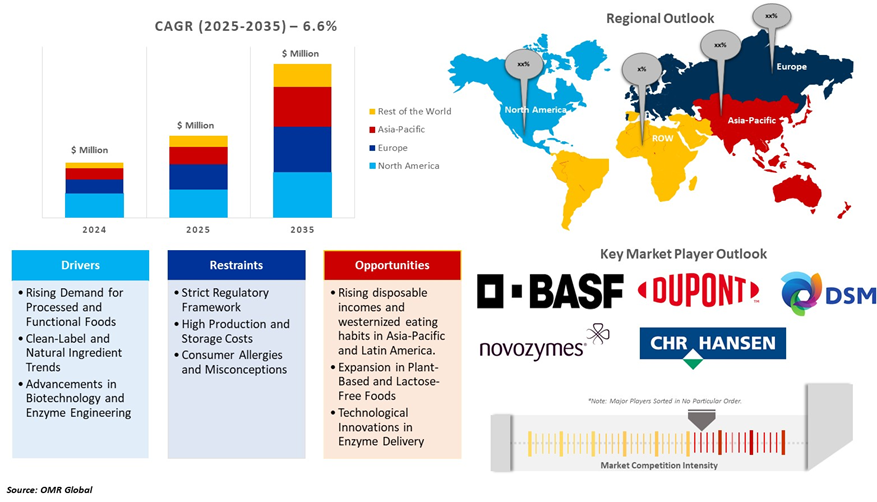
Food enzymes market was valued at $2,740 million in 2024, is projected to grow to $5,521 million with a CAGR of 6.6% during the forecast period (2025–2035). This growth is fueled by the increasing demand for processed foods, clean-label products, and functional foods with an enzyme component. Enzymes improve the nutritional profile of foods, improve texture, prolong shelf life, and reduce processing time, which coincide with global trends in health, sustainability, and efficiency. The Food and Agriculture Organization (FAO) has indicated that the use of enzymes in food processing can reduce energy use by 20-30% and waste by 15-25% and enables sustainable practice.
Market Dynamics
Increasing Health and Wellness Revolution
The global wellness trends have impacted the food enzymes market in a substantial way, and Generation Z and Millennial consumers—who have moved toward health-oriented food consumption practices—appear to be the main driver. Consequently, this market focus on functional foods/beverages represents significant opportunities for food enzyme companies to deliver targeted solutions that meet specific health needs. Additionally, the adoption of lactose-free products and beverages and the global trend towards health and wellness further propel the market growth. For instance, the global wellness economy has grown rapidly in the aftermath of the pandemic and reached $6.3 trillion in 2023.
Rising Demand for Processed and Convenience Foods
Food enzymes are vital natural catalysts used in the manufacturing of processed and convenience foods, allowing increased efficiency, quality, shelf life, and fulfilling the consumer's wants of clean label and sustainable food manufacturing. Food enzymes allow food manufacturers to: Reduce processing time (such as proteases, proteases allow meat to be tenderized and cooked 50% faster than the mechanical method of tenderization) and save up to 20-30% energy costs compared to chemical additives. Create/enhance shelf life using enzyme-based preserving agents (such as amylases postpone baking goods), which would overcome food waste exceeding 200 million tons of food waste a year in the world. Replace synthetic constituents or "artificial substances", and to meet clean label trends in the U.S., 65% of consumers are trying to be diligent in avoiding any artificial ingredients. Broaden nutritional properties and possibilities to use whole grains or fortified cereals; use phytases to increase absorption of minerals in cereal grain, which is crucial to produce snacks and ready-to-eat meal products.
Market Segmentation
- Based on the product, the market is segmented into proteases, lipases, carbohydrases, polymerases & nucleases, phytases, and catalases.
- Based on the source, the market is segmented into microorganisms, plants, and animals.
- Based on the formulation, the market is segmented into lyophilized powder, liquid, and other formulations.
- Based on the application, the market is segmented into food & beverage, processed food, dairy, bakery, and confectionery.
Impact of EU Regulations on Enzyme Safety 2025
EFSA's role: The European Food Safety Authority (EFSA) is responsible for evaluating the safety of enzymes used in food and feed. Our assessments of enzymes used in animal feed also consider their efficacy. Scientific advice is taken into account by the European Commission and national authorities when organizations decide whether or not to approve new enzymes and/or changes in their conditions of use. EFSA has two main functions with food enzymes:
- Evaluating all enzymes currently marketed or intended to be marketed in the EU during a submission period defined by EU legislation.
- Assessing applications for the authorization of new enzymes after an EU list of approved enzymes has been established.
EU framework: The Regulation on food enzymes, Regulation EC No 1332/2008, harmonises the provisions on the use of food enzymes in the EU. According to that regulation, all food enzymes must be subject to a safety evaluation by EFSA and then approved by the European Commission. Approved food enzymes will be included in the EU list of food enzymes.
There is currently no Union list of authorized food enzymes. This will be established once the evaluations are finalized. For the time being, the placing on the market and the use of food enzymes and of food produced with food enzymes are subject to national legislation.
Strong Demand for Carbohydrases Drives Market Share
Over the course of the forecast period, the food enzymes market is anticipated to be dominated by the carbohydrases segment. They are divided into cellulases, amylases, and other carbohydrases, including pullulanases, mannanases, lactases, and pectinases. Carbohydrases are employed in food applications to serve a variety of industries, including dairy, processed foods, bakeries, and confections. Their cost-effectiveness, reduced time and space consumption, and flexibility of process customization and optimization have given them additional benefits for a variety of culinary applications.
Regional Outlook
The global food enzymes is further divided by region, including North America (the US and Canada), Europe (the UK, Germany, France, Italy, Spain, Russia, and the Rest of Europe), Asia-Pacific (India, China, Japan, South Korea, Australia and New Zealand, ASEAN Countries, and the Rest of Asia-Pacific), and the Rest of the World (the Middle East & Africa, and Latin America).
North America is Expected to Significantly Contribute to the Growth of the Food Enzymes Market
North America holds the largest share of the global food enzymes market at over 35% in 2022. The increased need for processed foods in the U.S. and Canada, technological advancement for food ingredients and enzymes, and substantial capital investment into enzyme development have enabled the region to be the market leader. North America has an established food and beverage industry, an emerging processed food industry, and strong capital investment in biotechnological innovation. The market benefits from the preference of consumers in the region for high-quality natural foods, the introduction of new technologies and manufacturing processes, and government-supported innovation.
Market Players Outlook
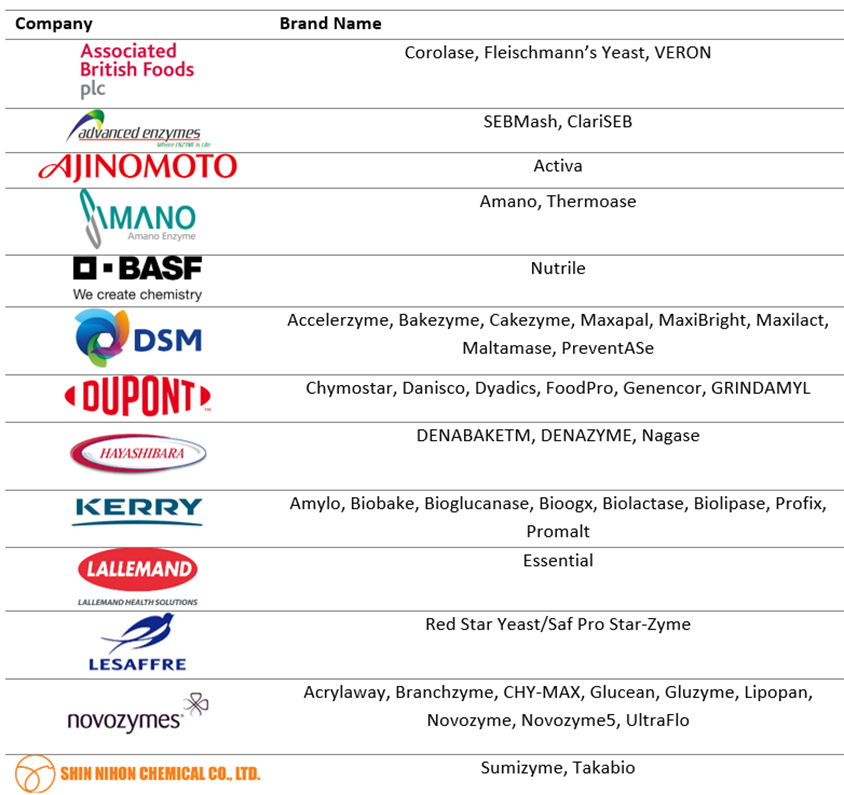
The major companies operating in the global food enzymes market include BASF, DuPont de Nemours, Inc., DSM-Firmenich AG, and Novozymes A/S (Novonesis Group), among others. Market players are leveraging partnerships, collaborations, mergers, and acquisition strategies for business expansion and innovative product development to maintain their market positioning.
Major Companies Operating In the Global Food Enzymes
Recent Developments
- In March 2025, Allozymes and Bonumose, a leader in innovative enzyme combinations enabling the production of high-volume, healthy, naturally occurring monosaccharides from commodity feedstocks such as starch and sugar, announced the preliminary results of improvements to key enzymes for Bonumose's ingredient production process.
- In March 2025, DSM-Firmenich introduced Maxiren EVO, the latest breakthrough in coagulant enzymes designed to transform cheese production. MaxirenEVO is engineered with cutting-edge fermentation technology and targets alpha s-1 (?s1) casein via a highly specific mode of action to deliver better texture and flavor development, improved yields, and increased processing flexibility.
- In June 2023, DSM-Firmenich introduced Maxilact, a new lactase enzyme, to expand its highly valued portfolio of Maxilact lactase enzymes to offer efficient lactose-free dairy production.
- In January 2022, BASF and Cargill announced their expanded agreement. Together, they are developing innovative enzyme-based solutions for the market, generating distinctive value for animal feed customers. With the expanded geographical reach, BASF and Cargill aim to bring the voice and commercial insights of U.S. protein producers to craft the next generation of enzymes jointly. Through this next stage of collaboration, BASF and Cargill strive to deliver solutions that address productivity, sustainability, and cost challenges for US customers.
The Report Covers
- Market value data analysis of 2024 and forecast to 2035.
- Annualized market revenues ($ million) for each market segment.
- Country-wise analysis of major geographical regions.
- Key companies operating in the global food enzymes market. Based on the availability of data, information related to new products and relevant news is also available in the report.
- Analysis of business strategies by identifying the key market segments positioned for strong growth in the future.
- Analysis of market-entry and market expansion strategies.
- Competitive strategies by identifying ‘who-stands-where’ in the market.
1. Report Summary
• Current Industry Analysis and Growth Potential Outlook
• Global Food Enzymes Market Sales Analysis – Product | Source | Formulation | Application ($ Million)
• Food Enzymes Market Sales Performance of Top Countries
1.1. Research Methodology
• Primary Research Approach
• Secondary Research Approach
1.2. Market Snapshot
2. Market Overview and Insights
2.1. Scope of the Study
2.2. Analyst Insight & Current Market Trends
2.2.1. Key Food Enzymes Market Trends
2.2.2. Market Recommendations
3. Market Determinants
3.1. Market Drivers
3.1.1. Drivers For the Global Food Enzymes Market: Impact Analysis
3.2. Market Pain Points and Challenges
3.2.1. Restraints For the Global Food Enzymes Market: Impact Analysis
3.3. Market Opportunities
4. Competitive Landscape
4.1. Competitive Dashboard – Food Enzymes Market Revenue and Share by Manufacturers
• Food Enzymes Product Comparison Analysis
• Top Market Player Ranking Matrix
4.2. Key Company Analysis
4.2.1. BASF SE
4.2.1.1. Overview
4.2.1.2. Product Portfolio
4.2.1.3. Financial Analysis (Subject to Data Availability)
4.2.1.4. SWOT Analysis
4.2.1.5. Business Strategy
4.2.2. DuPont de Nemours, Inc.
4.2.2.1. Overview
4.2.2.2. Product Portfolio
4.2.2.3. Financial Analysis (Subject to Data Availability)
4.2.2.4. SWOT Analysis
4.2.2.5. Business Strategy
4.2.3. DSM-Firmenich AG
4.2.3.1. Overview
4.2.3.2. Product Portfolio
4.2.3.3. Financial Analysis (Subject to Data Availability)
4.2.3.4. SWOT Analysis
4.2.3.5. Business Strategy
4.2.4. Chr. Hansen and Novozymes Groups
4.2.4.1. Overview
4.2.4.2. Product Portfolio
4.2.4.3. Financial Analysis (Subject to Data Availability)
4.2.4.4. SWOT Analysis
4.2.4.5. Business Strategy
4.2.5. Novozymes A/S (Novonesis Group)
4.2.5.1. Overview
4.2.5.2. Product Portfolio
4.2.5.3. Financial Analysis (Subject to Data Availability)
4.2.5.4. SWOT Analysis
4.2.5.5. Business Strategy
4.3. Top Winning Strategies by Market Players
4.3.1. Merger and Acquisition
4.3.2. Product Launch
4.3.3. Partnership And Collaboration
5. Global Food Enzymes Market Sales Analysis By Product ($ Million)
5.1. Proteases
5.2. Lipases
5.3. Carbohydrases
5.4. Polymerases & Nucleases
5.5. Phytases
5.6. Catalases
6. Global Food Enzymes Market Sales Analysis By Source ($ Million)
6.1. Microorganisms
6.2. Plants
6.3. Animals
7. Global Food Enzymes Market Sales Analysis By Formulation ($ Million)
7.1. Lyophilized Powder
7.2. Liquid
7.3. Other Formulations
8. Global Food Enzymes Market Sales Analysis By Application ($ Million)
8.1. Food & Beverage
8.2. Processed Food
8.3. Dairy
8.4. Bakery
8.5. Confectionary
9. Regional Analysis
9.1. North American Food Enzymes Market Sales Analysis – Product | Source | Formulation | Application ($ Million)
• Macroeconomic Factors for North America
9.1.1. United States
9.1.2. Canada
9.2. European Food Enzymes Market Sales Analysis – Product | Source | Formulation | Application ($ Million)
• Macroeconomic Factors for Europe
9.2.1. UK
9.2.2. Germany
9.2.3. Italy
9.2.4. Spain
9.2.5. France
9.2.6. Russia
9.2.7. Rest of Europe
9.3. Asia-Pacific Food Enzymes Market Sales Analysis – Product | Source | Formulation | Application ($ Million)
• Macroeconomic Factors for Asia-Pacific
9.3.1. China
9.3.2. Japan
9.3.3. South Korea
9.3.4. India
9.3.5. Australia & New Zealand
9.3.6. ASEAN Countries (Thailand, Indonesia, Vietnam, Singapore, And others)
9.3.7. Rest of Asia-Pacific
9.4. Rest of the World Food Enzymes Market Sales Analysis – Product | Source | Formulation | Application ($ Million)
• Macroeconomic Factors for the Rest of the World
9.4.1. Latin America
9.4.2. Middle East and Africa
10. Company Profiles
10.1. AB Enzymes GmbH
10.1.1. Quick Facts
10.1.2. Company Overview
10.1.3. Product Portfolio
10.1.4. Business Strategies
10.2. Advanced Enzyme Technologies.
10.2.1. Quick Facts
10.2.2. Company Overview
10.2.3. Product Portfolio
10.2.4. Business Strategies
10.3. Amano Enzyme Inc.
10.3.1. Quick Facts
10.3.2. Company Overview
10.3.3. Product Portfolio
10.3.4. Business Strategies
10.4. Asahi Kasei Pharma Corp.
10.4.1. Quick Facts
10.4.2. Company Overview
10.4.3. Product Portfolio
10.4.4. Business Strategies
10.5. Aumgene Biosciences
10.5.1. Quick Facts
10.5.2. Company Overview
10.5.3. Product Portfolio
10.5.4. Business Strategies
10.6. Aumenzymes.
10.6.1. Quick Facts
10.6.2. Company Overview
10.6.3. Product Portfolio
10.6.4. Business Strategies
10.7. Antozyme Biotech Pvt Ltd,
10.7.1. Quick Facts
10.7.2. Company Overview
10.7.3. Product Portfolio
10.7.4. Business Strategies
10.8. Adisseo France S.A.S
10.8.1. Quick Facts
10.8.2. Company Overview
10.8.3. Product Portfolio
10.8.4. Business Strategies
10.9. BASF
10.9.1. Quick Facts
10.9.2. Company Overview
10.9.3. Product Portfolio
10.9.4. Business Strategies
10.10. Biocatalysts Ltd (BRAIN Biotech Group)
10.10.1. Quick Facts
10.10.2. Company Overview
10.10.3. Product Portfolio
10.10.4. Business Strategies
10.11. Chr. Hansen and Novozymes Groups
10.11.1. Quick Facts
10.11.2. Company Overview
10.11.3. Product Portfolio
10.11.4. Business Strategies
10.12. Codexis Inc.
10.12.1. Quick Facts
10.12.2. Company Overview
10.12.3. Product Portfolio
10.12.4. Business Strategies
10.13. DSM-Firmenich AG
10.13.1. Quick Facts
10.13.2. Company Overview
10.13.3. Product Portfolio
10.13.4. Business Strategies
10.14. DuPont de Nemours, Inc.
10.14.1. Quick Facts
10.14.2. Company Overview
10.14.3. Product Portfolio
10.14.4. Business Strategies
10.15. Enzyme Innovation (Specialty Enzymes & Probiotics)
10.15.1. Quick Facts
10.15.2. Company Overview
10.15.3. Product Portfolio
10.15.4. Business Strategies
10.16. F. Hoffmann-La Roche Ltd
10.16.1. Quick Facts
10.16.2. Company Overview
10.16.3. Product Portfolio
10.16.4. Business Strategies
10.17. International Flavors & Fragrances Inc.
10.17.1. Quick Facts
10.17.2. Company Overview
10.17.3. Product Portfolio
10.17.4. Business Strategies
10.18. Jiangsu Boli Bioproducts Co., Ltd.
10.18.1. Quick Facts
10.18.2. Company Overview
10.18.3. Product Portfolio
10.18.4. Business Strategies
10.19. Kerry Group plc
10.19.1. Quick Facts
10.19.2. Company Overview
10.19.3. Product Portfolio
10.19.4. Business Strategies
10.20. Lumis Biotech Pvt. Ltd.
10.20.1. Quick Facts
10.20.2. Company Overview
10.20.3. Product Portfolio
10.20.4. Business Strategies
10.21. Novozymes A/S (Novonesis Group)
10.21.1. Quick Facts
10.21.2. Company Overview
10.21.3. Product Portfolio
10.21.4. Business Strategies
10.22. Novus International, Inc.
10.22.1. Quick Facts
10.22.2. Company Overview
10.22.3. Product Portfolio
10.22.4. Business Strategies
10.23. Nature BioScience Pvt. L.T.D.,
10.23.1. Quick Facts
10.23.2. Company Overview
10.23.3. Product Portfolio
10.23.4. Business Strategies
10.24. Proteozymes
10.24.1. Quick Facts
10.24.2. Company Overview
10.24.3. Product Portfolio
10.24.4. Business Strategies
10.25. Specialty Enzymes & Probiotics
10.25.1. Quick Facts
10.25.2. Company Overview
10.25.3. Product Portfolio
10.25.4. Business Strategies
1. Global Food Enzymes Market Research And Analysis By Product, 2024-2035 ($ Million)
2. Global Proteases Enzymes Market Research And Analysis By Region, 2024-2035 ($ Million)
3. Global Lipases Enzymes Market Research And Analysis By Region, 2024-2035 ($ Million)
4. Global Carbohydrases Enzymes Market Research And Analysis By Region, 2024-2035 ($ Million)
5. Global Polymerases & Nucleases Enzymes Market Research And Analysis By Region, 2024-2035 ($ Million)
6. Global Phytases Enzymes Market Research And Analysis By Region, 2024-2035 ($ Million)
7. Global Catalases Enzymes Market Research And Analysis By Region, 2024-2035 ($ Million)
8. Global Food Enzymes Market Research And Analysis By Source, 2024-2035 ($ Million)
9. Global Microorganisms-Based Enzymes Market Research And Analysis By Region, 2024-2035 ($ Million)
10. Global Plant-Based Enzymes Market Research And Analysis By Region, 2024-2035 ($ Million)
11. Global Animals-Based Enzymes Market Research And Analysis By Region, 2024-2035 ($ Million)
12. Global Food Enzymes Market Research And Analysis By Formulation, 2024-2035 ($ Million)
13. Global Lyophilized Powder Enzymes Market Research And Analysis By Region, 2024-2035 ($ Million)
14. Global Liquid Enzymes Market Research And Analysis By Region, 2024-2035 ($ Million)
15. Global Other Formulations Enzymes Market Research And Analysis By Region, 2024-2035 ($ Million)
16. Global Food Enzymes Market Research And Analysis By Application, 2024-2035 ($ Million)
17. Global Food Enzymes For Food & Beverage Market Research And Analysis By Region, 2024-2035 ($ Million)
18. Global Food Enzymes For Processed Food Market Research And Analysis By Region, 2024-2035 ($ Million)
19. Global Food Enzymes For Dairy Market Research And Analysis By Region, 2024-2035 ($ Million)
20. Global Food Enzymes For Bakery Market Research And Analysis By Region, 2024-2035 ($ Million)
21. Global Food Enzymes For Confectionary Research Market Research And Analysis By Region, 2024-2035 ($ Million)
22. Global Food Enzymes Market Research And Analysis By Region, 2024-2035 ($ Million)
23. North American Food Enzymes Market Research And Analysis By Country, 2024-2035 ($ Million)
24. North American Food Enzymes Market Research And Analysis By Product, 2024-2035 ($ Million)
25. North American Food Enzymes Market Research And Analysis By Source, 2024-2035 ($ Million)
26. North American Food Enzymes Market Research And Analysis By Formulation, 2024-2035 ($ Million)
27. North American Food Enzymes Market Research And Analysis By Application, 2024-2035 ($ Million)
28. European Food Enzymes Market Research And Analysis By Country, 2024-2035 ($ Million)
29. European Food Enzymes Market Research And Analysis By Product, 2024-2035 ($ Million)
30. European Food Enzymes Market Research And Analysis By Source, 2024-2035 ($ Million)
31. European Food Enzymes Market Research And Analysis By Formulation, 2024-2035 ($ Million)
32. European Food Enzymes Market Research And Analysis By Application, 2024-2035 ($ Million)
33. Asia-Pacific Food Enzymes Market Research And Analysis By Country, 2024-2035 ($ Million)
34. Asia-Pacific Food Enzymes Market Research And Analysis By Product, 2024-2035 ($ Million)
35. Asia-Pacific Food Enzymes Market Research And Analysis By Source, 2024-2035 ($ Million)
36. Asia-Pacific Food Enzymes Market Research And Analysis By Formulation, 2024-2035 ($ Million)
37. Asia-Pacific Food Enzymes Market Research And Analysis By Application, 2024-2035 ($ Million)
38. Rest of the World Food Enzymes Market Research And Analysis By Country, 2024-2035 ($ Million)
39. Rest of the World Food Enzymes Market Research And Analysis By Product, 2024-2035 ($ Million)
40. Rest of the World Food Enzymes Market Research And Analysis By Source, 2024-2035 ($ Million)
41. Rest of the World Food Enzymes Market Research And Analysis By Formulation, 2024-2035 ($ Million)
42. Rest of the World Food Enzymes Market Research And Analysis By Application, 2024-2035 ($ Million)
1. Global Food Enzymes Market Research And Analysis By Product, 2024 Vs 2035 (%)
2. Global Proteases Enzymes Market Research And Analysis By Region, 2024 Vs 2035 (%)
3. Global Lipases Enzymes Market Research And Analysis By Region, 2024 Vs 2035 (%)
4. Global Carbohydrases Enzymes Market Research And Analysis By Region, 2024 Vs 2035 (%)
5. Global Polymerases & Nucleases Enzymes Market Research And Analysis By Region, 2024 Vs 2035 (%)
6. Global Phytases Enzymes Market Research And Analysis By Region, 2024 Vs 2035 (%)
7. Global Catalases Enzymes Market Research And Analysis By Region, 2024 Vs 2035 (%)
8. Global Food Enzymes Market Research And Analysis By Source, 2024 Vs 2035 (%)
9. Global Microorganisms-Based Enzymes Market Research And Analysis By Region, 2024 Vs 2035 (%)
10. Global Plant-Based Enzymes Market Research And Analysis By Region, 2024 Vs 2035 (%)
11. Global Animals-Based Enzymes Market Research And Analysis By Region, 2024 Vs 2035 (%)
12. Global Food Enzymes Market Research And Analysis By Formulation, 2024 Vs 2035 (%)
13. Global Lyophilized Powder Enzymes Market Research And Analysis By Region, 2024 Vs 2035 (%)
14. Global Liquid Enzymes Market Research And Analysis By Region, 2024 Vs 2035 (%)
15. Global Other Formulations Enzymes Market Research And Analysis By Region, 2024 Vs 2035 (%)
16. Global Food Enzymes Market Research And Analysis By Application, 2024 Vs 2035 (%)
17. Global Food Enzymes For Food & Beverage Market Research And Analysis By Region, 2024 Vs 2035 (%)
18. Global Food Enzymes For Processed Food Market Research And Analysis By Region, 2024 Vs 2035 (%)
19. Global Food Enzymes For Dairy Market Research And Analysis By Region, 2024 Vs 2035 (%)
20. Global Food Enzymes For Bakery Market Research And Analysis By Region, 2024 Vs 2035 (%)
21. Global Food Enzymes For Confectionary Research Market Research And Analysis By Region, 2024 Vs 2035 (%)
22. Global Food Enzymes Market Share By Country, 2024 Vs 2035 (%)
23. US Food Enzymes Market Size, 2024-2035 ($ Million)
24. Canada Food Enzymes Market Size, 2024-2035 ($ Million)
25. UK Food Enzymes Market Size, 2024-2035 ($ Million)
26. France Food Enzymes Market Size, 2024-2035 ($ Million)
27. Germany Food Enzymes Market Size, 2024-2035 ($ Million)
28. Italy Food Enzymes Market Size, 2024-2035 ($ Million)
29. Spain Food Enzymes Market Size, 2024-2035 ($ Million)
30. Russia Food Enzymes Market Size, 2024-2035 ($ Million)
31. Rest Of Europe Food Enzymes Market Size, 2024-2035 ($ Million)
32. India Food Enzymes Market Size, 2024-2035 ($ Million)
33. China Food Enzymes Market Size, 2024-2035 ($ Million)
34. Japan Food Enzymes Market Size, 2024-2035 ($ Million)
35. Australia And New Zealand Food Enzymes Market Size, 2024-2035 ($ Million)
36. ASEAN Economies Food Enzymes Market Size, 2024-2035 ($ Million)
37. South Korea Food Enzymes Market Size, 2024-2035 ($ Million)
38. Rest Of Asia-Pacific Food Enzymes Market Size, 2024-2035 ($ Million)
39. Latin America Food Enzymes Market Size, 2024-2035 ($ Million)
40. Middle East And Africa Food Enzymes Product Market Size, 2024-2035 ($ Million)
- Printable version
- No restriction to number of users within the company