Offshore Wind Energy Market


Offshore Wind Energy Market Size, Share & Trends Analysis Report by Component (Turbine, Electrical Structure, Support Structure and Others) by Installation Type (Fixed Structure and Floating Structure) by Location (Shallow Water (<30m), Transitional Water (30–60m), Deep Water (>60m)), by Capacity (Up to 3 MW, 3 MW to 5 MW and Above 5 MW), and by End Users (Residential, Commercial and Industrial), Forecast Period (2025-2035)
Industry Overview
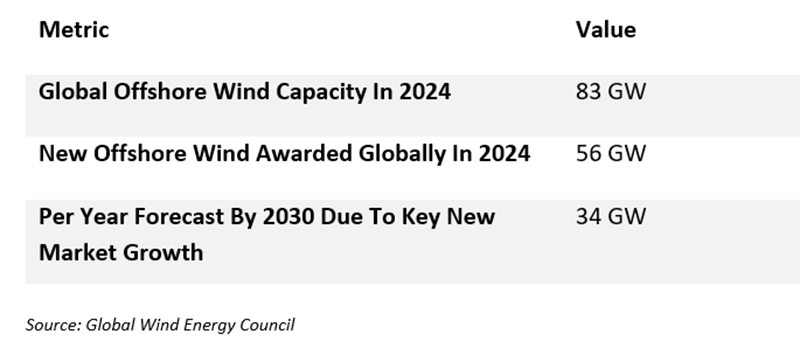
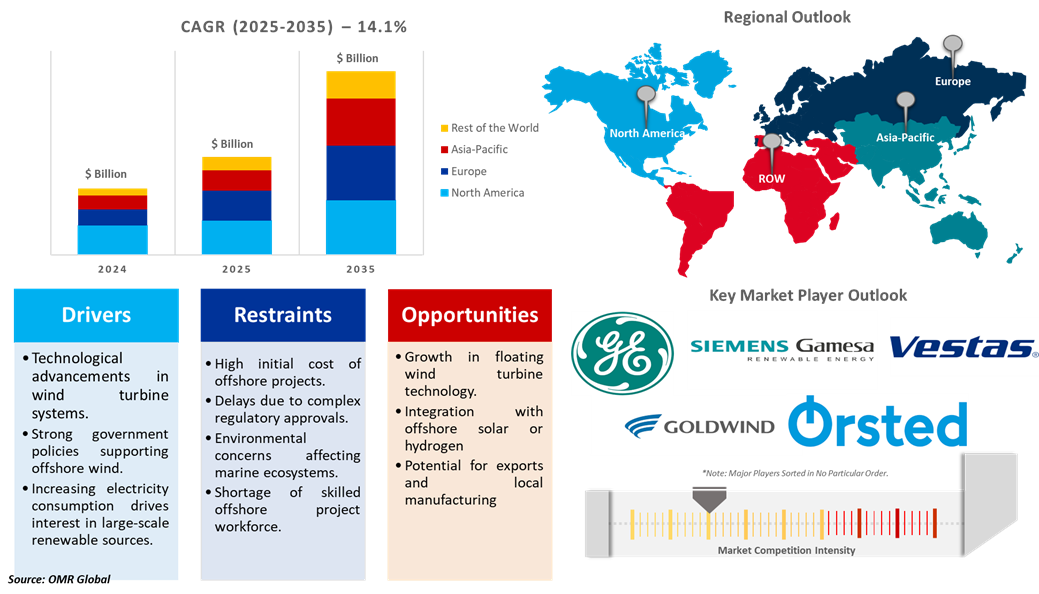
Offshore wind energy market was valued at $52.10 billion in 2024 and is projected to reach $249.32 billion by 2035, growing at a CAGR of 14.1% during the forecast period (2025–2035). The global offshore wind energy market is expanding at a fast pace owing to the rising demand for clean and renewable energy, government policies and incentives, decarbonization of industry and power sectors, high wind speeds, and scalability in offshore locations and infrastructure and technological advancements. Offshore wind energy continues to advance rapidly, with significant milestones being achieved in both turbine technology and project development. Recent progress includes record-breaking turbine capacities and the commissioning of major offshore wind farms in nations such as the US, UK, China, and more. This progress is demonstrated by developments such as:
Global Offshore Wind Market Overview
- Current fixed offshore wind turbines like the GE Vernova Haliade-X turbines used in the UK’s Dogger Bank Wind Farm are rated at 13 MW, while Dongfang Electric publicly tested a 26 MW fixed bottom turbine in June 2025.
- In the US, the 132-MW South Fork Wind Farm, which began operations in December 2023 and was completely commissioned in March 2024, became the country's first operational commercial wind farm. The 12-turbine project is estimated to provide renewable energy to over 70,000 homes in the New York area. Additionally, there are about 60 offshore wind projects in various stages of development across the US.
Market Dynamics
Advancing Offshore Wind Operations through AI and Digital Twin Applications
Artificial intelligence (AI) is quickly advancing, with an increasing number of applications in the offshore wind sector. AI is now used in wind resource evaluation, environmental impact assessment, and predictive maintenance. As the offshore wind industry increasingly embraces digital innovation, advanced monitoring technologies are being developed to enhance performance, safety, and maintenance efficiency. For instance, in November 2023, 2H was awarded two projects, including the production of a digital twin for the TetraSpar wind demonstration project. 2H intends to continue developing and testing the digital twin for real-time monitoring of floating wind. The digital twin model will construct a virtual reproduction of the turbine and its components, allowing for remote performance monitoring, early defect identification, and predictive maintenance planning of substructure components such as the foundation, tower, and mooring lines. Machine learning technology, together with a finite element analysis model, will be utilized to create a digital duplicate of an existing floating wind platform that includes pre-trained algorithms.
Rising Costs and Contractual Pressures in the Offshore Wind Sector
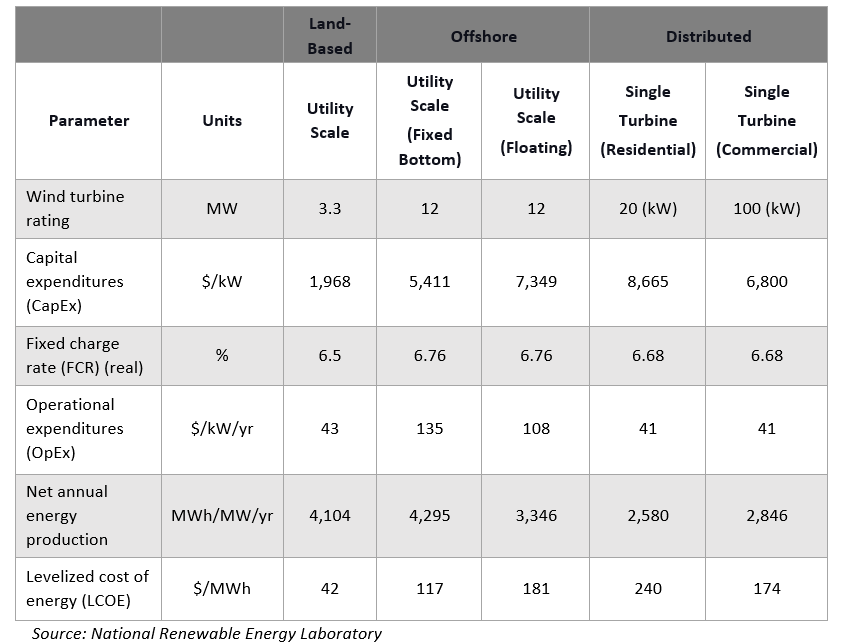
Offshore wind energy is generally more expensive than onshore wind energy due to the higher costs associated with installation, maintenance, and infrastructure. Building and servicing turbines at sea requires specialized equipment, vessels, and materials that can withstand harsh marine conditions. Additionally, offshore projects often need long subsea cables and offshore substations to connect to the power grid.
In countries such US and Germany, the offshore wind business is currently challenged by rising costs, regulatory delays, and grid connection challenges, all of which lead to low returns. Inflation and supply chain issues have increased capital spending, while rising interest rates have caused borrowing prices to rise significantly. Developers are looking to renegotiate previously agreed-upon offtake transactions that are no longer profitable, and some are trying to cancel their contracts entirely. For instance, in July 2023, Avangrid, the US affiliate of Spanish electrical giant Iberdrola, recently agreed to pay the state of Massachusetts $48.9 million in fines to cease its commitment to the "Commonwealth Wind" offshore farm, which is still under development. Furthermore, companies such as Shell-Ocean Winds, BP-Equinor, and Orsted-Eversource are now attempting to revise their electricity offtake agreements.
Key Inputs and Levelized Cost of Energy Results
Market Segmentation
- Based on the component, the market is segmented into turbine, electrical structure, support structure, and others.
- Based on the installation type, the market is segmented into fixed structure and floating structure.
- Based on the location, the market is segmented into shallow water (<30m), transitional water (30–60m), and deep water (>60m).
- Based on the capacity, the market is segmented into Up to 3 MW, 3 MW to 5 MW, and Above 5 MW.
- Based on end user, the market is segmented into residential, commercial, and industrial.
Global Push toward Cost-Effective Floating Offshore Wind Solutions
Floating turbines are more expensive now, owing to improved technology and lower production numbers. However, the cost is falling. As additional projects are developed and floating systems become standardised, the economics are likely to improve. Several countries are making large-scale investments in floating wind, with the goal of lowering prices to fixed-bottom levels within the next decade. For instance, in July 2025, Ocean Winds (OW) announced the successful installation of the first floating wind turbine of its Éoliennes Flottantes du Golfe du Lion (EFGL) project in France, developed in partnership with Banque des Territoires. Assembled at the port of Port-La Nouvelle in Occitanie, the first of three 10?MW turbines.
Furthermore, countries such as Japan, which have been unable to use much of their deep territorial waters for wind power, could use floating turbines as a source of renewable energy. Japan has set an ambitious target to reach 30–45 GW of wind energy capacity by 2040, with floating wind turbines expected to play a significant role.
Regional Outlook
The global offshore wind energy market is further divided by region, including North America (the US and Canada), Europe (the UK, Germany, France, Italy, Spain, Russia, and the Rest of Europe), Asia-Pacific (India, China, Japan, South Korea, Australia and New Zealand, ASEAN Countries, and the Rest of Asia-Pacific), and the Rest of the World (the Middle East & Africa, and Latin America).
Asia-Pacific is Leading the Global Offshore Wind Energy Market
Asia–Pacific is leading the offshore wind energy market, driven by China’s global leadership and aggressive offshore expansion, rising regional energy demand and urbanization, and policy-driven domestic manufacturing. In 2025, China maintained its global leadership in new offshore wind installations for the seventh consecutive year. The country remains the dominant force in the offshore wind sector, accounting for approximately 50% of the total global cumulative capacity, followed by the UK. Domestically, the autonomous regions of Xinjiang and Inner Mongolia represent a significant share of China’s prospective renewable energy capacity, hosting 40% (523 GW) of the national total. Notably, these two regions alone account for nearly 212 GW—equivalent to 31% of the global utility-scale solar and wind capacity currently under construction.
Furthermore, nations such as India have been actively promoting domestic manufacturing and supply to reduce import dependency and strengthen self-reliance. For instance, the recent amendment to the ALMM (Wind) mandates sourcing of key wind turbine components—accounting for 65–70% of total turbine cost—from ALMM-listed domestic suppliers. This levels the cost gap between Indian and Chinese OEMs, whose turbines are currently 10–15% cheaper due to imports. Indian OEMs, already holding 40–45% market share, are better positioned to benefit from this shift. The localization of data and R&D facilities will also enhance cybersecurity and technological self-reliance. Together, these measures are expected to strengthen domestic manufacturing, support credit profiles, and accelerate growth in India’s wind energy sector, which aims to reach 140 GW by 2030.
Europe Continues to be a Stronghold for the Offshore Wind Energy Market Globally
Europe holds a significant share offshore wind energy market owing to technological advancements and cost reduction, strategic geographic location, supportive government policies with energy goals, and infrastructure development and grid expansion. Wind energy’s direct contribution to the European GDP in 2030 is expected to be EUR 49 billion. New wind energy installations in Europe totaled 18.3 GW in 2023 (the EU installed 16.2 GW), with offshore wind accounting for 21 per cent of this, with 3.8 GW of wind farm capacity connected to the grid. Nearly half of the newly connected capacity was in the Netherlands (1.9 GW), with the remainder coming from the UK (833 MW), France (360 MW), Denmark (344 MW), Germany (329 MW), and Norway (35 MW).
In 2023, offshore wind saw a major surge in new project investments, with final investment decisions (FIDs) approved for 9 GW of capacity. Funding for these projects hit a record €30 billion, marking a sharp rebound from 2022, when investment activity was limited. That same year, European governments allocated 27 GW of new wind energy capacity through auctions, evenly split among onshore and offshore wind at 13.5 GW each.
Major market players have been continuously increasing their market presence across Europe. Industry leaders such as Vestas are expanding their market presence with more than 51 offshore projects across countries like the UK, Netherlands, Belgium, Sweden, Denmark, and Germany, as well as emerging floating wind initiatives in Portugal and Scotland. Furthermore, the company has more than 1,500 turbines installed at sea and over 10 GW of capacity deployed across 56 projects globally.
Market Players Outlook
The major companies operating in the global offshore wind energy market include GE Vernova, Inc., Goldwind Science & Technology Co., Ltd., Ørsted A/S, Siemens Gamesa Renewable Energy, S.A.U., Vestas Wind Systems A/S, among others. Market players are leveraging partnerships, collaborations, mergers, and acquisition strategies for business expansion and innovative product development to maintain their market positioning.
The Report Covers
- Market value data analysis of 2024 and forecast to 2035.
- Annualized market revenues ($ million) for each market segment.
- Country-wise analysis of major geographical regions.
- Key companies operating in the global offshore wind energy market. Based on the availability of data, information related to new products and relevant news is also available in the report.
- Analysis of business strategies by identifying the key market segments positioned for strong growth in the future.
- Analysis of market-entry and market expansion strategies.
- Competitive strategies by identifying ‘who-stands-where’ in the market.
- Report Summary
- Current Industry Analysis and Growth Potential Outlook
- Global Offshore Wind Energy Market Sales Analysis – Component| Installation Type| Location| Capacity| End Users ($ Million)
- Offshore Wind Energy Market Sales Market Sales Performance of Top Countries
- Research Methodology
- Primary Research Approach
- Secondary Research Approach
- Market Snapshot
- Market Overview and Insights
- Scope of the Study
- Analyst Insight & Current Market Trends
- Key Offshore Wind Energy Market Trends
- Market Recommendations
- Market Determinants
- Market Drivers
- Drivers For Global Offshore Wind Energy Market: Impact Analysis
- Market Pain Points and Challenges
- Restraints For Global Offshore Wind Energy Market: Impact Analysis
- Market Opportunities
- Opportunities For Global Offshore Wind Energy Market: Impact Analysis
- Market Drivers
- Competitive Landscape
- Competitive Dashboard – Offshore Wind Energy Market Revenue and Share by Manufacturers
- Offshore Wind Energy Manufacturer Comparison Analysis
- Top Market Player Ranking Matrix
- Key Company Analysis
- GE Vernova, Inc.
- Overview
- Battery Type Portfolio
- Financial Analysis (Subject to Data Availability)
- SWOT Analysis
- Business Strategy
- Goldwind Science&Technology Co., Ltd.
- Overview
- Battery Type Portfolio
- Financial Analysis (Subject to Data Availability)
- SWOT Analysis
- Business Strategy
- Ørsted A/S
- Overview
- Battery Type Portfolio
- Financial Analysis (Subject to Data Availability)
- SWOT Analysis
- Business Strategy
- Siemens Gamesa Renewable Energy, S.A.U.
- Overview
- Battery Type Portfolio
- Financial Analysis (Subject to Data Availability)
- SWOT Analysis
- Business Strategy
- Vestas Wind Systems A/S
- Overview
- Battery Type Portfolio
- Financial Analysis (Subject to Data Availability)
- SWOT Analysis
- Business Strategy
- GE Vernova, Inc.
- Key Company Analysis
- Top Winning Strategies by Market Players
- Merger and Acquisition
- Battery Type Launch
- Partnership And Collaboration
- Global Offshore Wind Energy Market Sales Analysis By Components ($ Million)
- Turbine
- Electrical Structure
- Support Structure
- Others
- Global Offshore Wind Energy Market Sales Analysis By Installation Type ($ Million)
- Fixed Structure
- Floating Structure
- Global Offshore Wind Energy Market Sales Analysis By Location ($ Million)
- Shallow Water (<30m)
- Transitional Water (30–60m)
- Deep Water (>60m)
- Global Offshore Wind Energy Market Sales Analysis By Capacity ($ Million)
- Up to 3 MW
- 3 MW to 5 MW
- Above 5 MW
- Global Offshore Wind Energy Market Sales Analysis By End Users ($ Million)
- Residential
- Commercial
- Industrial
- Regional Analysis
- North American Offshore Wind Energy Market Sales Analysis – Components | Installation Type | Location | Capacity | End Users | Country ($ Million)
- Macroeconomic Factors for North America
- United States
- Canada
- European Offshore Wind Energy Market Sales Analysis – Components | Installation Type | Location | Capacity | End Users | Country ($ Million)
- Macroeconomic Factors for Europe
- UK
- Germany
- Italy
- Spain
- France
- Russia
- Rest of Europe
- Asia-Pacific Offshore Wind Energy Market Sales Analysis – Components | Installation Type | Location | Capacity | End Users | Country ($ Million)
- Macroeconomic Factors for Asia-Pacific
- China
- Japan
- South Korea
- India
- Australia & New Zealand
- ASEAN Countries (Thailand, Indonesia, Vietnam, Singapore, And others)
- Rest of Asia-Pacific
- Rest of the World Offshore Wind Energy Market Sales Analysis – Components | Installation Type | Location | Capacity | End Users | Country ($ Million)
- Macroeconomic Factors for the Rest of the World
- Latin America
- Middle East and Africa
- Company Profiles
- BW Ideol
- Quick Facts
- Company Overview
- Product Portfolio
- Business Strategies
- Dominion Energy, Inc.
- Quick Facts
- Company Overview
- Product Portfolio
- Business Strategies
- EDF Renewables Inc.
- Quick Facts
- Company Overview
- Product Portfolio
- Business Strategies
- Envision Energy Ltd.
- Quick Facts
- Company Overview
- Product Portfolio
- Business Strategies
- Equinor ASA
- Quick Facts
- Company Overview
- Product Portfolio
- Business Strategies
- GE Vernova, Inc.
- Quick Facts
- Company Overview
- Product Portfolio
- Business Strategies
- Goldwind Science&Technology Co., Ltd.
- Quick Facts
- Company Overview
- Product Portfolio
- Business Strategies
- Iberdrola, S.A.
- Quick Facts
- Company Overview
- Product Portfolio
- Business Strategies
- Marubeni Offshore Wind Development Co., Ltd.
- Quick Facts
- Company Overview
- Product Portfolio
- Business Strategies
- Nordex SE
- Quick Facts
- Company Overview
- Product Portfolio
- Business Strategies
- Northland Power Inc
- Quick Facts
- Company Overview
- Product Portfolio
- Business Strategies
- Ørsted A/S
- Quick Facts
- Company Overview
- Product Portfolio
- Business Strategies
- OW OFFSHORE S.L.
- Quick Facts
- Company Overview
- Product Portfolio
- Business Strategies
- Parkwind NV
- Quick Facts
- Company Overview
- Product Portfolio
- Business Strategies
- RES Group
- Quick Facts
- Company Overview
- Product Portfolio
- Business Strategies
- RWE Offshore Wind GmbH
- Quick Facts
- Company Overview
- Product Portfolio
- Business Strategies
- Shell Plc.
- Quick Facts
- Company Overview
- Product Portfolio
- Business Strategies
- Siemens Gamesa Renewable Energy, S.A.U.
- Quick Facts
- Company Overview
- Product Portfolio
- Business Strategies
- TotalEnergies SE
- Quick Facts
- Company Overview
- Product Portfolio
- Business Strategies
- Vattenfall AB
- Quick Facts
- Company Overview
- Product Portfolio
- Business Strategies
- Vestas Wind Systems A/S
- Quick Facts
- Company Overview
- Product Portfolio
- Business Strategies
- Business Strategies
- Van Oord NV
- Quick Facts
- Company Overview
- Product Portfolio
- Business Strategies
- BW Ideol
1. Global Offshore Wind Energy Market Research and Analysis By Component, 2024-2035 ($ Million)
2. Global Offshore Wind Energy Turbine Market Research and Analysis By Region, 2024-2035 ($ Million)
3. Global Offshore Wind Energy Electrical Structure Market Research and Analysis By Region, 2024-2035 ($ Million)
4. Global Offshore Wind Energy Support Structure Market Research and Analysis By Region, 2024-2035 ($ Million)
5. Global Offshore Wind Energy Other Component Market Research and Analysis By Region, 2024-2035 ($ Million)
6. Global Offshore Wind Energy Market Research and Analysis By Installation Type, 2024-2035 ($ Million)
7. Global Fixed Structure Offshore Wind Energy Market Research and Analysis By Region, 2024-2035 ($ Million)
8. Global Fixed Structure Offshore Wind Energy Market Research and Analysis By Region, 2024-2035 ($ Million)
9. Global Offshore Wind Energy Market Research and Analysis By Location, 2024-2035 ($ Million)
10. Global Shallow Water Offshore Wind Energy Market Research and Analysis By Region, 2024-2035 ($ Million)
11. Global Transitional Water Offshore Wind Energy Market Research and Analysis By Region, 2024-2035 ($ Million)
12. Global Deep Water Offshore Wind Energy Market Research and Analysis By Region, 2024-2035 ($ Million)
13. Global Offshore Wind Energy Market Research and Analysis By Capacity, 2024-2035 ($ Million)
14. Global Offshore Wind Energy Up to 3 MW Market Research and Analysis By Region, 2024-2035 ($ Million)
15. Global Offshore Wind Energy of 3 MW to 5 MW Market Research and Analysis By Region, 2024-2035 ($ Million)
16. Global Offshore Wind Energy Above 5 MW Market Research and Analysis By Region, 2024-2035 ($ Million)
17. Global Offshore Wind Energy Market Research and Analysis By End Users, 2024-2035 ($ Million)
18. Global Offshore Wind Energy For Residential Market Research and Analysis By Region, 2024-2035 ($ Million)
19. Global Offshore Wind Energy For Commercial Market Research and Analysis By Region, 2024-2035 ($ Million)
20. Global Offshore Wind Energy For Industrial Market Research and Analysis By Region, 2024-2035 ($ Million)
21. Global Offshore Wind Energy Market Research and Analysis By Region, 2024-2035 ($ Million)
22. North American Offshore Wind Energy Market Research and Analysis By Country, 2024-2035 ($ Million)
23. North American Offshore Wind Energy Market Research and Analysis By Component, 2024-2035 ($ Million)
24. North American Offshore Wind Energy Market Research and Analysis By Installation Type, 2024-2035 ($ Million)
25. North American Offshore Wind Energy Market Research and Analysis By Location, 2024-2035 ($ Million)
26. North American Offshore Wind Energy Market Research and Analysis By Capacity, 2024-2035 ($ Million)
27. North American Offshore Wind Energy Market Research and Analysis By End Users, 2024-2035 ($ Million)
28. European Offshore Wind Energy Market Research and Analysis By Country, 2024-2035 ($ Million)
29. European Offshore Wind Energy Market Research and Analysis By Component, 2024-2035 ($ Million)
30. European Offshore Wind Energy Market Research and Analysis By Installation Type, 2024-2035 ($ Million)
31. European Offshore Wind Energy Market Research and Analysis By Location, 2024-2035 ($ Million)
32. European Offshore Wind Energy Market Research and Analysis By Capacity, 2024-2035 ($ Million)
33. European Offshore Wind Energy Market Research and Analysis By End Users, 2024-2035 ($ Million)
34. Asia-Pacific Offshore Wind Energy Market Research and Analysis By Country, 2024-2035 ($ Million)
35. Asia-Pacific Offshore Wind Energy Market Research and Analysis By Component, 2024-2035 ($ Million)
36. Asia-Pacific Offshore Wind Energy Market Research and Analysis By Installation Type, 2024-2035 ($ Million)
37. Asia-Pacific Offshore Wind Energy Market Research and Analysis By Location, 2024-2035 ($ Million)
38. Asia-Pacific Offshore Wind Energy Market Research and Analysis By Capacity, 2024-2035 ($ Million)
39. Asia-Pacific Offshore Wind Energy Market Research and Analysis By End Users, 2024-2035 ($ Million)
40. Rest of The World Offshore Wind Energy Market Research and Analysis By Country, 2024-2035 ($ Million)
41. Rest of The World Offshore Wind Energy Market Research and Analysis By Component, 2024-2035 ($ Million)
42. Rest of The World Offshore Wind Energy Market Research and Analysis By Installation Type, 2024-2035 ($ Million)
43. Rest of The World Offshore Wind Energy Market Research and Analysis By Location, 2024-2035 ($ Million)
44. Rest of The World Offshore Wind Energy Market Research and Analysis By Capacity, 2024-2035 ($ Million)
45. Rest of The World Offshore Wind Energy Market Research and Analysis By End Users, 2024-2035 ($ Million)
1. Global Offshore Wind Energy Market Share By Propulsion Type, 2024 Vs 2035 (%)
2. Global Offshore Wind Energy Turbine Market Share By Region, 2024 Vs 2035 (%)
3. Global Offshore Wind Energy Electrical Structure Market Share By Region, 2024 Vs 2035 (%)
4. Global Offshore Wind Energy Support Structure Market Share By Region, 2024 Vs 2035 (%)
5. Global Offshore Wind Energy Other Component Market Share By Region, 2024 Vs 2035 (%)
6. Global Offshore Wind Energy Market Share By Installation Type, 2024 Vs 2035 (%)
7. Global Fixed Structure Offshore Wind Energy Market Share By Region, 2024 Vs 2035 (%)
8. Global Floating Structure Offshore Wind Energy Market Share By Region, 2024 Vs 2035 (%)
9. Global Offshore Wind Energy Market Share By Location, 2024 Vs 2035 (%)
10. Global Shallow Water Offshore Wind Energy Market Share By Region, 2024 Vs 2035 (%)
11. Global Transitional Water Offshore Wind Energy Market Share By Region, 2024 Vs 2035 (%)
12. Global Deep Water Offshore Wind Energy Market Share By Region, 2024 Vs 2035 (%)
13. Global Offshore Wind Energy Market Share By Capacity, 2024 Vs 2035 (%)
14. Global Offshore Wind Energy Up to 3 MW Market Share By Region, 2024 Vs 2035 (%)
15. Global Offshore Wind Energy of 3 MW to 5 MW Market Share By Region, 2024 Vs 2035 (%)
16. Global Offshore Wind Energy Above 5 MW Market Share By Region, 2024 Vs 2035 (%)
17. Global Offshore Wind Energy Market Share By End Users, 2024 Vs 2035 (%)
18. Global Offshore Wind Energy For Residential Market Share By Region, 2024 Vs 2035 (%)
19. Global Offshore Wind Energy For Commercial Market Share By Region, 2024 Vs 2035 (%)
20. Global Offshore Wind Energy For Industrial Market Share By Region, 2024 Vs 2035 (%)
21. US Offshore Wind Energy Market Size, 2024-2035 ($ Million)
22. Canada Offshore Wind Energy Market Size, 2024-2035 ($ Million)
23. UK Offshore Wind Energy Market Size, 2024-2035 ($ Million)
24. France Offshore Wind Energy Market Size, 2024-2035 ($ Million)
25. Germany Offshore Wind Energy Market Size, 2024-2035 ($ Million)
26. Italy Offshore Wind Energy Market Size, 2024-2035 ($ Million)
27. Spain Offshore Wind Energy Market Size, 2024-2035 ($ Million)
28. Russia Offshore Wind Energy Market Size, 2024-2035 ($ Million)
29. Rest of Europe Offshore Wind Energy Market Size, 2024-2035 ($ Million)
30. India Offshore Wind Energy Market Size, 2024-2035 ($ Million)
31. China Offshore Wind Energy Market Size, 2024-2035 ($ Million)
32. Japan Offshore Wind Energy Market Size, 2024-2035 ($ Million)
33. South Korea Offshore Wind Energy Market Size, 2024-2035 ($ Million)
34. Australia and New Zealand Offshore Wind Energy Market Size, 2024-2035 ($ Million)
35. ASEAN Economies Offshore Wind Energy Market Size, 2024-2035 ($ Million)
36. Rest of Asia-Pacific Offshore Wind Energy Market Size, 2024-2035 ($ Million)
37. Latin America Offshore Wind Energy Market Size, 2024-2035 ($ Million)
38. Middle East and Africa Offshore Wind Energy Market Size, 2024-2035 ($ Million)
- Printable version
- No restriction to number of users within the company