Processed Seafood Market


Processed Seafood Market Size, Share & Trends Analysis Report by Seafood Type (Fish, Shrimps, Crabs, Tuna, Roe, and Molluscs), by Product Type (Frozen Products, Smoked Products, Canned Products, Dried Products, and Others), and by Distribution Channel (Online and Offline), Forecast Period (2025-2035)
Industry Overview
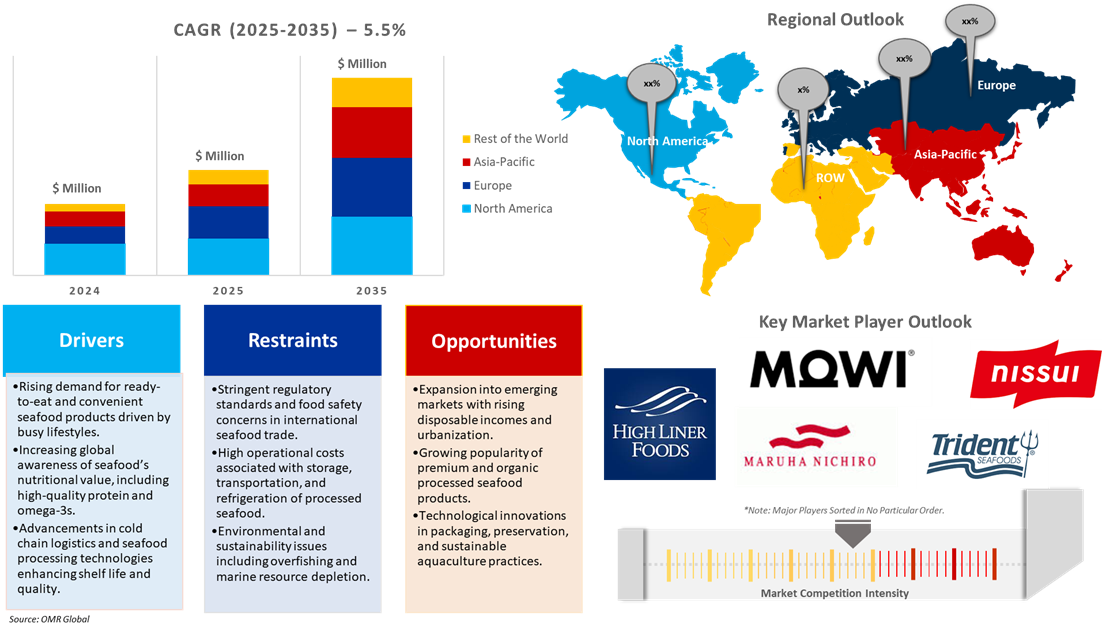
Processed seafood market size was valued at $263.5 billion in 2024 and is anticipated to reach $466.4 billion in 2035, increasing at a CAGR of 5.5% during the forecast period (2025-2035). The beneficial properties of processed seafood attract consumers and increase the consumption of seafood. Processed seafood contains vitamin B12, phosphorus, magnesium, potassium, and others, which are also medically recommended and beneficial to keeping low cholesterol levels and fighting cancer and tumor growth. The benefits associated with the consumption of processed seafood, such as lowering heart attacks, boosting brain health, helping to prevent and treat depression, and others, drive the growth of the processed seafood market globally. Additionally, this growth is primarily driven by the increasing global seafood production. For instance, the Food and Agriculture Organization (FAO) of the United Nations, states that in June 2024, the State of World Fisheries and Aquaculture (SOFIA) said global fisheries and aquaculture production in 2022 surged to 223.2 million tons, a 4.4% increase from the year 2020. Production comprised 185.4 million tons of aquatic animals and 37.8 million tons of algae.
Market Dynamics
Growing Seafood Production and Consumption Driving Market Growth
The steady increase in world fisheries and aquaculture production is a robust support for growth in the processed seafood industry. According to the FAO, Global apparent consumption of aquatic animal foods reached 162.5 million tons in 2021. This growth has increased at nearly double the rate of the world population since 1961, with global per capita annual consumption rising from 9.1 kg in 1961 to 20.7 kg in 2022. In addition, Aquatic foods provide high-quality proteins – 15% of animal proteins and 6% of total proteins worldwide – and key nutrients including omega-3 fatty acids, minerals, and vitamins. For instance, in 2021, they contributed at least 20% of the per capita protein supply from all animal sources to 3.2 billion people.
Supporting Regulatory Standards Ensuring Product Quality
Government agencies around the globe set tough standards for seafood processing and trade that have led to better product quality and safety. For instance, the European Union, the largest fish and seafood product importer in the world, has set harmonized importing regulations among all its member states to ensure strict hygiene, consumer protection, and animal health standards. These regulations make processors use better quality measures, which ultimately feed the market with safer products. All other interested parties and private businesses wishing to export to the EU should contact their competent authority which in turn will communicate with the European Commission.
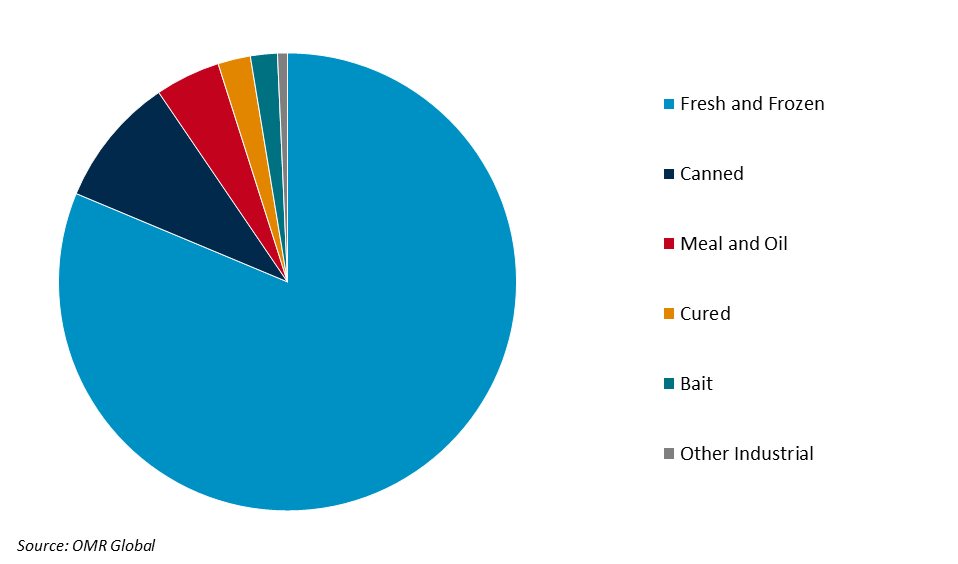
Distribution of Processed Fishery Products by Category (in %), US 2022
Market Segmentation
- Based on the seafood type, the market is segmented into fish, shrimp, crabs, tuna, roe, and molluscs.
- Based on the product type, the market is segmented into frozen products, smoked products, canned products, dried products, and others.
- Based on the distribution channel, the market is segmented into online and offline.
Fish Segment Dominates the Global Processed Seafood Market
Based on seafood type, the fish category occupies the largest portion of the processed seafood market because of its general acceptability and diversity of forms across different processing techniques. Edible finfish, for instance, registered $5.27 billion in 2022, as per U.S. fisheries statistics, which demonstrates its high market value. The realization that numerous fish species can be used in multiple processing methods drives this category to remain in the top position.
Regional Outlook
The global processed seafood market is further divided by region, including North America (the US and Canada), Europe (the UK, Germany, France, Italy, Spain, Russia, and the Rest of Europe), Asia-Pacific (India, China, Japan, South Korea, Australia and New Zealand, ASEAN Countries, and the Rest of Asia-Pacific), and the Rest of the World (the Middle East & Africa, and Latin America).
North America Represents a Mature Market with Steady Growth
North America holds a big market share with stable growth opportunities. The American fisheries sector played an important role in the market with local production of processed fishery products worth $13.1 billion in 2022. U.S. consumers strongly prefer quick and easy-to-prepare seafood foods, especially frozen and canned goods. In 2022, U.S. commercial fishermen landed approximately 8.4 billion pounds (3.8 million metric tons) of edible and industrial fishery products at ports across all 50 states. This represented a 2.6% decline in volume—223.9 million pounds less—compared to 2021. The total value of these landings dropped by 11%, amounting to $5.9 billion, which is $632.2 million lower than the previous year.
Foreign Trade Highlights of the US
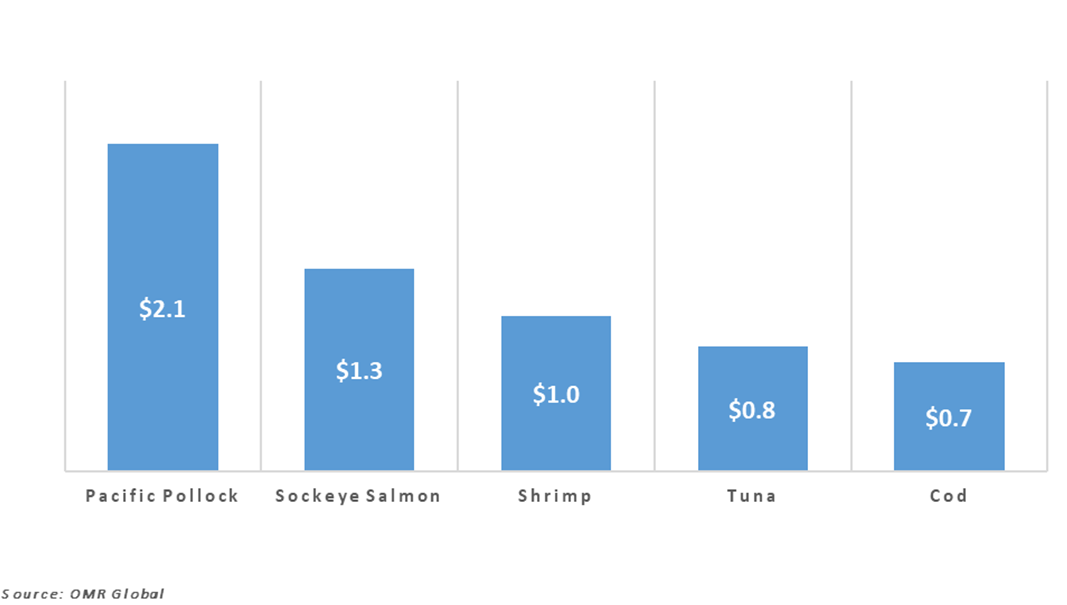
To meet a strong U.S. demand for seafood, the United States imported 6.9 billion pounds of seafood products valued at $29.7 billion. The top imported products were shrimp, salmon fillets/steaks, whole crabs, whole lobster, and whole salmon. Shrimp remains the most valuable overall import, accounting for 26% of the value of total edible imports. The United States also exported 2.5 billion pounds of seafood valued at $5.5 billion. The top-valued exports included: whole lobster, surimi, whole sockeye salmon, caviar/roe, and Alaska pollock fillets/steaks.
Recreational Fisheries Highlights
Additionally, the recreational fishing industry, along with its associated businesses, continued to provide Americans with engaging recreational opportunities. U.S. anglers took 201 million trips in 2022. These recreational anglers caught an estimated 1.1 billion fish and released 61% of those caught. The total recreational harvest was estimated at 437 million fish with a combined weight of 356.2 million pounds. By weight, striped bass was the top species harvested, with anglers harvesting 35.9 million pounds (3.5 million fish) in 2022. By number of fish, scup was the top species harvested, with anglers harvesting 17.7 million fish in 2022.
Processed Products Highlights
The estimated value of the 2022 domestic production of edible and industrial processed fishery products was $13.1 billion, up $411.3 million (3.2%) from 2021. The value of edible products was $12.2 billion, up $271.5 million (2.3%) compared with 2021. The value of industrial products was $947.6 million in 2022, up $139.8 million (17%) from 2021.
US Highest Value Processed Fishery Species Groups in 2022 (in $ Billion)
Asia-Pacific Region is expected to hold a Prominent Share in the Global Processed Seafood Market
Geographically, the Asia-Pacific region is expected to hold a prominent share of the global processed seafood market due to the increasing number of health-conscious people in India and China. China is the largest exporter of seafood items. According to the Food and Agriculture Organization of the United Nations, Asian countries continue to remain the major exporters of fish for human consumption. For instance, Nandu’s, India’s largest hyperlocal and omnichannel meat retail brand, has announced its expansion into fish and seafood retail. The company has added fish and seafood to its category of offerings across all its sales channels.
Market Players Outlook
The major companies operating in the global processed seafood market include Maruha Nichiro Corp., Mowi ASA, Nippon Suisan Kaisha (Nissui Corp.), Trident Seafoods, High Liner Foods, Seaboard Corp., and Thai Union Group Public Company Ltd., among others. Market players are leveraging partnerships, collaborations, mergers, and acquisition strategies for business expansion and innovative product development to maintain their market positioning.
Recent Developments
- In January 2025, Quick-service restaurant chain Tantalizers PLC announced the acquisition of DanBethel Marine Services Ltd., marking a significant step in entering the supplier space. This move focuses on industrial fish trawling, aquaculture, mariculture, seafood supplies, and marine operations.
- In December 2024, Pacific Seafood and Trident Seafoods jointly announced the completion of Pacific’s acquisition of Trident’s Kodiak, Alaska, processing operations. The acquisition includes three well-established processing plants—Star of Kodiak, Alkod, and Kodiak near Island—as well as the Plaza bunkhouse apartments for team member housing. Trident’s Kodiak team members will be retained by Pacific Seafood, ensuring continuity and stability for the team and the local community.
- In November 2024, the Aleutian Pribilof Island Community Development Association (APICDA) acquired a processing facility in False Pass, Alaska, from Silver Bay Seafoods. Under this acquisition, APIDCA, a Community Development Quota (CDQ) group, will lease the facility out to Silver Bay, which will manage the processing operations, including a fuel facility on site, the two companies said in a joint statement.
- In March 2024, Captain Fresh announced the acquisition of CenSea Inc. The acquisition marks a significant milestone for Captain Fresh’s expansion efforts. Captain Fresh emphasized CenSea’s robust supply network, particularly in India and Southeast Asia, where it maintains longstanding relationships with over 100 factory partners.
The Report Covers
- Market value data analysis of 2024 and forecast to 2035.
- Annualized market revenues ($ million) for each market segment.
- Country-wise analysis of major geographical regions.
- Key companies operating in the global processed seafood market. Based on the availability of data, information related to new products and relevant news is also available in the report.
- Analysis of business strategies by identifying the key market segments positioned for strong growth in the future.
- Analysis of market-entry and market expansion strategies.
- Competitive strategies by identifying ‘who-stands-where’ in the market.
1. Report Summary
• Current Industry Analysis and Growth Potential Outlook
• Global Processed Seafood Market Sales Analysis – Seafood Type | Product Type | Distribution Channel ($ Million)
• Processed Seafood Market Sales Performance of Top Countries
1.1. Research Methodology
• Primary Research Approach
• Secondary Research Approach
1.2. Market Snapshot
2. Market Overview and Insights
2.1. Scope of the Study
2.2. Analyst Insight & Current Market Trends
2.2.1. Key Processed Seafood Industry Trends
2.2.2. Market Recommendations
3. Market Determinants
3.1. Market Drivers
3.1.1. Drivers For Global Processed Seafood Market: Impact Analysis
3.2. Market Pain Points and Challenges
3.2.1. Restraints For Global Processed Seafood Market: Impact Analysis
3.3. Market Opportunities
4. Competitive Landscape
4.1. Competitive Dashboard – Processed Seafood Market Revenue and Share by Manufacturers
• Processed Seafood Product Comparison Analysis
• Top Market Player Ranking Matrix
4.2. Key Company Analysis
4.2.1. Maruha Nichiro Corp.
4.2.1.1. Overview
4.2.1.2. Product Portfolio
4.2.1.3. Financial Analysis (Subject to Data Availability)
4.2.1.4. SWOT Analysis
4.2.1.5. Business Strategy
4.2.2. Mowi ASA
4.2.2.1. Overview
4.2.2.2. Product Portfolio
4.2.2.3. Financial Analysis (Subject to Data Availability)
4.2.2.4. SWOT Analysis
4.2.2.5. Business Strategy
4.2.3. Nippon Suisan Kaisha (Nissui Corp.)
4.2.3.1. Overview
4.2.3.2. Product Portfolio
4.2.3.3. Financial Analysis (Subject to Data Availability)
4.2.3.4. SWOT Analysis
4.2.3.5. Business Strategy
4.2.4. Trident Seafoods
4.2.4.1. Overview
4.2.4.2. Product Portfolio
4.2.4.3. Financial Analysis (Subject to Data Availability)
4.2.4.4. SWOT Analysis
4.2.4.5. Business Strategy
4.2.5. High Liner Foods
4.2.5.1. Overview
4.2.5.2. Product Portfolio
4.2.5.3. Financial Analysis (Subject to Data Availability)
4.2.5.4. SWOT Analysis
4.2.5.5. Business Strategy
4.3. Top Winning Strategies by Market Players
4.3.1. Merger and Acquisition
4.3.2. Product Launch
4.3.3. Partnership And Collaboration
5. Global Processed Seafood Market Sales Analysis By Seafood Type ($ Million)
5.1. Fish
5.2. Shrimps
5.3. Crabs
5.4. Tuna
5.5. Roe
5.6. Molluscs
6. Global Processed Seafood Market Sales Analysis By Product Type ($ Million)
6.1. Frozen Products
6.2. Smoked Products
6.3. Canned Products
6.4. Dried Products
6.5. Others
7. Global Processed Seafood Market Sales Analysis By Distribution Channel ($ Million)
7.1. Online
7.2. Offline
8. Regional Analysis
8.1. North American Processed Seafood Market Sales Analysis – Seafood Type | Product Type | Distribution Channel ($ Million)
• Macroeconomic Factors for North America
8.1.1. United States
8.1.2. Canada
8.2. European Processed Seafood Market Sales Analysis – Seafood Type | Product Type | Distribution Channel ($ Million)
• Macroeconomic Factors for Europe
8.2.1. UK
8.2.2. Germany
8.2.3. Italy
8.2.4. Spain
8.2.5. France
8.2.6. Russia
8.2.7. Rest of Europe
8.3. Asia-Pacific Processed Seafood Market Sales Analysis – Seafood Type | Product Type | Distribution Channel ($ Million)
• Macroeconomic Factors for Asia-Pacific
8.3.1. China
8.3.2. Japan
8.3.3. South Korea
8.3.4. India
8.3.5. Australia & New Zealand
8.3.6. ASEAN Countries (Thailand, Indonesia, Vietnam, Singapore, And Other)
8.3.7. Rest of Asia-Pacific
8.4. Rest of the World Processed Seafood Market Sales Analysis – Seafood Type | Product Type | Distribution Channel ($ Million)
• Macroeconomic Factors for the Rest of the World
8.4.1. Latin America
8.4.2. Middle East and Africa
9. Company Profiles
9.1. Abad Fisheries Pvt. Ltd.
9.1.1. Quick Facts
9.1.2. Company Overview
9.1.3. Product Portfolio
9.1.4. Business Strategies
9.2. Apex Frozen Foods Ltd.
9.2.1. Quick Facts
9.2.2. Company Overview
9.2.3. Product Portfolio
9.2.4. Business Strategies
9.3. Acme Smoked Fish Holding Corp.
9.3.1. Quick Facts
9.3.2. Company Overview
9.3.3. Product Portfolio
9.3.4. Business Strategies
9.4. August Seafoods
9.4.1. Quick Facts
9.4.2. Company Overview
9.4.3. Product Portfolio
9.4.4. Business Strategies
9.5. Bristol Seafood LLC
9.5.1. Quick Facts
9.5.2. Company Overview
9.5.3. Product Portfolio
9.5.4. Business Strategies
9.6. Bumble Bee Foods, LLC
9.6.1. Quick Facts
9.6.2. Company Overview
9.6.3. Product Portfolio
9.6.4. Business Strategies
9.7. Charoen Pokphand Foods PCL
9.7.1. Quick Facts
9.7.2. Company Overview
9.7.3. Product Portfolio
9.7.4. Business Strategies
9.8. Camanchaca S.A.
9.8.1. Quick Facts
9.8.2. Company Overview
9.8.3. Product Portfolio
9.8.4. Business Strategies
9.9. Coastal Corp. Ltd.
9.9.1. Quick Facts
9.9.2. Company Overview
9.9.3. Product Portfolio
9.9.4. Business Strategies
9.10. Clearwater
9.10.1. Quick Facts
9.10.2. Company Overview
9.10.3. Product Portfolio
9.10.4. Business Strategies
9.11. EverFresh Seafood Company
9.11.1. Quick Facts
9.11.2. Company Overview
9.11.3. Product Portfolio
9.11.4. Business Strategies
9.12. Fisher Boy (High Liner Foods, Inc.)
9.12.1. Quick Facts
9.12.2. Company Overview
9.12.3. Product Portfolio
9.12.4. Business Strategies
9.13. Falcon Marine Exports (Falcon Group)
9.13.1. Quick Facts
9.13.2. Company Overview
9.13.3. Product Portfolio
9.13.4. Business Strategies
9.14. Geo Seafood
9.14.1. Quick Facts
9.14.2. Company Overview
9.14.3. Product Portfolio
9.14.4. Business Strategies
9.15. Greenland Seafood Europe GmbH
9.15.1. Quick Facts
9.15.2. Company Overview
9.15.3. Product Portfolio
9.15.4. Business Strategies
9.16. KARAVELA SIA
9.16.1. Quick Facts
9.16.2. Company Overview
9.16.3. Product Portfolio
9.16.4. Business Strategies
9.17. Lerøy Seafood Group ASA
9.17.1. Quick Facts
9.17.2. Company Overview
9.17.3. Product Portfolio
9.17.4. Business Strategies
9.18. Maruha Nichiro Corp.
9.18.1. Quick Facts
9.18.2. Company Overview
9.18.3. Product Portfolio
9.18.4. Business Strategies
9.19. Marubeni Seafoods Corporation
9.19.1. Quick Facts
9.19.2. Company Overview
9.19.3. Product Portfolio
9.19.4. Business Strategies
9.20. Mazzetta Company, LLC
9.20.1. Quick Facts
9.20.2. Company Overview
9.20.3. Product Portfolio
9.20.4. Business Strategies
9.21. Mowi ASA
9.21.1. Quick Facts
9.21.2. Company Overview
9.21.3. Product Portfolio
9.21.4. Business Strategies
9.22. Ocean Beauty Seafoods LLC
9.22.1. Quick Facts
9.22.2. Company Overview
9.22.3. Product Portfolio
9.22.4. Business Strategies
9.23. Pescanova, Inc.
9.23.1. Quick Facts
9.23.2. Company Overview
9.23.3. Product Portfolio
9.23.4. Business Strategies
9.24. Phillips Foods, Inc.
9.24.1. Quick Facts
9.24.2. Company Overview
9.24.3. Product Portfolio
9.24.4. Business Strategies
9.25. PT Japfa Comfeed Indonesia Tbk.
9.25.1. Quick Facts
9.25.2. Company Overview
9.25.3. Product Portfolio
9.25.4. Business Strategies
9.26. Russian Fishery Company, LLC
9.26.1. Quick Facts
9.26.2. Company Overview
9.26.3. Product Portfolio
9.26.4. Business Strategies
9.27. Seaboard Corp.
9.27.1. Quick Facts
9.27.2. Company Overview
9.27.3. Product Portfolio
9.27.4. Business Strategies
9.28. SEASAGA GROUPS
9.28.1. Quick Facts
9.28.2. Company Overview
9.28.3. Product Portfolio
9.28.4. Business Strategies
9.29. Silver Sea Food
9.29.1. Quick Facts
9.29.2. Company Overview
9.29.3. Product Portfolio
9.29.4. Business Strategies
9.30. Thai Union Group Public Company Ltd.
9.30.1. Quick Facts
9.30.2. Company Overview
9.30.3. Product Portfolio
9.30.4. Business Strategies
9.31. The Waterbase Ltd.
9.31.1. Quick Facts
9.31.2. Company Overview
9.31.3. Product Portfolio
9.31.4. Business Strategies
9.32. Tri Marine Group
9.32.1. Quick Facts
9.32.2. Company Overview
9.32.3. Product Portfolio
9.32.4. Business Strategies
9.33. Trident Seafoods Corp.
9.33.1. Quick Facts
9.33.2. Company Overview
9.33.3. Product Portfolio
9.33.4. Business Strategies
9.34. Vinh Hoan Corp.
9.34.1. Quick Facts
9.34.2. Company Overview
9.34.3. Product Portfolio
9.34.4. Business Strategies
9.35. Zhanjiang Guolian Aquatic Products Co., Ltd.
9.35.1. Quick Facts
9.35.2. Company Overview
9.35.3. Product Portfolio
9.35.4. Business Strategies
1. Global Processed Seafood Market Research And Analysis By Seafood Type, 2024-2035 ($ Million)
2. Global Fish Processed Seafood Market Research And Analysis By Region, 2024-2035 ($ Million)
3. Global Shrimps Processed Seafood Market Research And Analysis By Region, 2024-2035 ($ Million)
4. Global Crabs Processed Seafood Market Research And Analysis By Region, 2024-2035 ($ Million)
5. Global Tuna Processed Seafood Market Research And Analysis By Region, 2024-2035 ($ Million)
6. Global Roe Processed Seafood Market Research And Analysis By Region, 2024-2035 ($ Million)
7. Global Molluscs Processed Seafood Market Research And Analysis By Region, 2024-2035 ($ Million)
8. Global Processed Seafood Market Research And Analysis By Product Type, 2024-2035 ($ Million)
9. Global Frozen Processed Seafood Products Market Research And Analysis By Region, 2024-2035 ($ Million)
10. Global Smoked Processed Seafood Products Market Research And Analysis By Region, 2024-2035 ($ Million)
11. Global Canned Processed Seafood Products Market Research And Analysis By Region, 2024-2035 ($ Million)
12. Global Dried Processed Seafood Products Market Research And Analysis By Region, 2024-2035 ($ Million)
13. Global Other Processed Seafood Products Market Research And Analysis By Region, 2024-2035 ($ Million)
14. Global Processed Seafood Market Research And Analysis By Distribution Channel, 2024-2035 ($ Million)
15. Global Online Processed Seafood Market Research And Analysis By Region, 2024-2035 ($ Million)
16. Global Offline Processed Seafood Market Research And Analysis By Region, 2024-2035 ($ Million)
17. Global Processed Seafood Market Research And Analysis By Region, 2024-2035 ($ Million)
18. North American Processed Seafood Market Research And Analysis By Country, 2024-2035 ($ Million)
19. North American Processed Seafood Market Research And Analysis By Seafood Type, 2024-2035 ($ Million)
20. North American Processed Seafood Market Research And Analysis By Product Type, 2024-2035 ($ Million)
21. North American Processed Seafood Market Research And Analysis By Distribution Channel, 2024-2035 ($ Million)
22. European Processed Seafood Market Research And Analysis By Country, 2024-2035 ($ Million)
23. European Processed Seafood Market Research And Analysis By Seafood Type, 2024-2035 ($ Million)
24. European Processed Seafood Market Research And Analysis By Product Type, 2024-2035 ($ Million)
25. European Processed Seafood Market Research And Analysis By Distribution Channel, 2024-2035 ($ Million)
26. Asia-Pacific Processed Seafood Market Research And Analysis By Country, 2024-2035 ($ Million)
27. Asia-Pacific Processed Seafood Market Research And Analysis By Seafood Type, 2024-2035 ($ Million)
28. Asia-Pacific Processed Seafood Market Research And Analysis By Product Type, 2024-2035 ($ Million)
29. Asia-Pacific Processed Seafood Market Research And Analysis By Distribution Channel, 2024-2035 ($ Million)
30. Rest Of The World Processed Seafood Market Research And Analysis By Region, 2024-2035 ($ Million)
31. Rest Of The World Processed Seafood Market Research And Analysis By Seafood Type, 2024-2035 ($ Million)
32. Rest Of The World Processed Seafood Market Research And Analysis By Product Type, 2024-2035 ($ Million)
33. Rest Of The World Processed Seafood Market Research And Analysis By Distribution Channel, 2024-2035 ($ Million)
1. Global Processed Seafood Market Share By Seafood Type, 2024 Vs 2035 (%)
2. Global Fish Processed Seafood Market Share By Region, 2024 Vs 2035 (%)
3. Global Shrimps Processed Seafood Market Share By Region, 2024 Vs 2035 (%)
4. Global Crabs Processed Seafood Market Region By Region, 2024 Vs 2035 (%)
5. Global Tuna Processed Seafood Market Region By Region, 2024 Vs 2035 (%)
6. Global Roe Processed Seafood Market Region By Region, 2024 Vs 2035 (%)
7. Global Molluscs Processed Seafood Market Region By Region, 2024 Vs 2035 (%)
8. Global Processed Seafood Market Share By Product Type, 2024 Vs 2035 (%)
9. Global Frozen Processed Seafood Products Market Share By Region, 2024 Vs 2035 (%)
10. Global Smoked Processed Seafood Products Market Share By Region, 2024 Vs 2035 (%)
11. Global Canned Processed Seafood Products Market Share By Region, 2024 Vs 2035 (%)
12. Global Dried Processed Seafood Products Market Share By Region, 2024 Vs 2035 (%)
13. Global Other Processed Seafood Products Market Share By Region, 2024 Vs 2035 (%)
14. Global Processed Seafood Market Share By Distribution Channel, 2024 Vs 2035 (%)
15. Global Online Processed Seafood Market Share By Region, 2024 Vs 2035 (%)
16. Global Offline Processed Seafood Market Share By Region, 2024 Vs 2035 (%)
17. Global Processed Seafood Market Share By Region, 2024 Vs 2035 (%)
18. US Processed Seafood Market Size, 2024-2035 ($ Million)
19. Canada Processed Seafood Market Size, 2024-2035 ($ Million)
20. UK Processed Seafood Market Size, 2024-2035 ($ Million)
21. France Processed Seafood Market Size, 2024-2035 ($ Million)
22. Germany Processed Seafood Market Size, 2024-2035 ($ Million)
23. Italy Processed Seafood Market Size, 2024-2035 ($ Million)
24. Spain Processed Seafood Market Size, 2024-2035 ($ Million)
25. Russia Processed Seafood Market Size, 2024-2035 ($ Million)
26. Rest Of Europe Processed Seafood Market Size, 2024-2035 ($ Million)
27. India Processed Seafood Market Size, 2024-2035 ($ Million)
28. China Processed Seafood Market Size, 2024-2035 ($ Million)
29. Japan Processed Seafood Market Size, 2024-2035 ($ Million)
30. South Korea Processed Seafood Market Size, 2024-2035 ($ Million)
31. Australia and New Zealand Processed Seafood Market Size, 2024-2035 ($ Million)
32. ASEAN Economies Processed Seafood Market Size, 2024-2035 ($ Million)
33. Rest Of Asia-Pacific Processed Seafood Market Size, 2024-2035 ($ Million)
34. Latin America Processed Seafood Market Size, 2024-2035 ($ Million)
35. Middle East and Africa Processed Seafood Market Size, 2024-2035 ($ Million)
- Printable version
- No restriction to number of users within the company

