Thermal Management Technologies Market


Thermal Management Technologies Market Size, Share & Trends Analysis Report by Material Type (Adhesive Materials, and Non-adhesive Materials), by Device (Conduction Cooling Devices, Convection Cooling Devices, Advanced Cooling Devices, and Hybrid Cooling Devices), by Service (Installation & Calibration, and Optimization & Post-Sales Support), and by End-User (Consumer Electronics, Servers & Data Centers, Automotive, Aerospace & Defense, Enterprises, and Others), Forecast Period (2025-2035)
Industry Overview
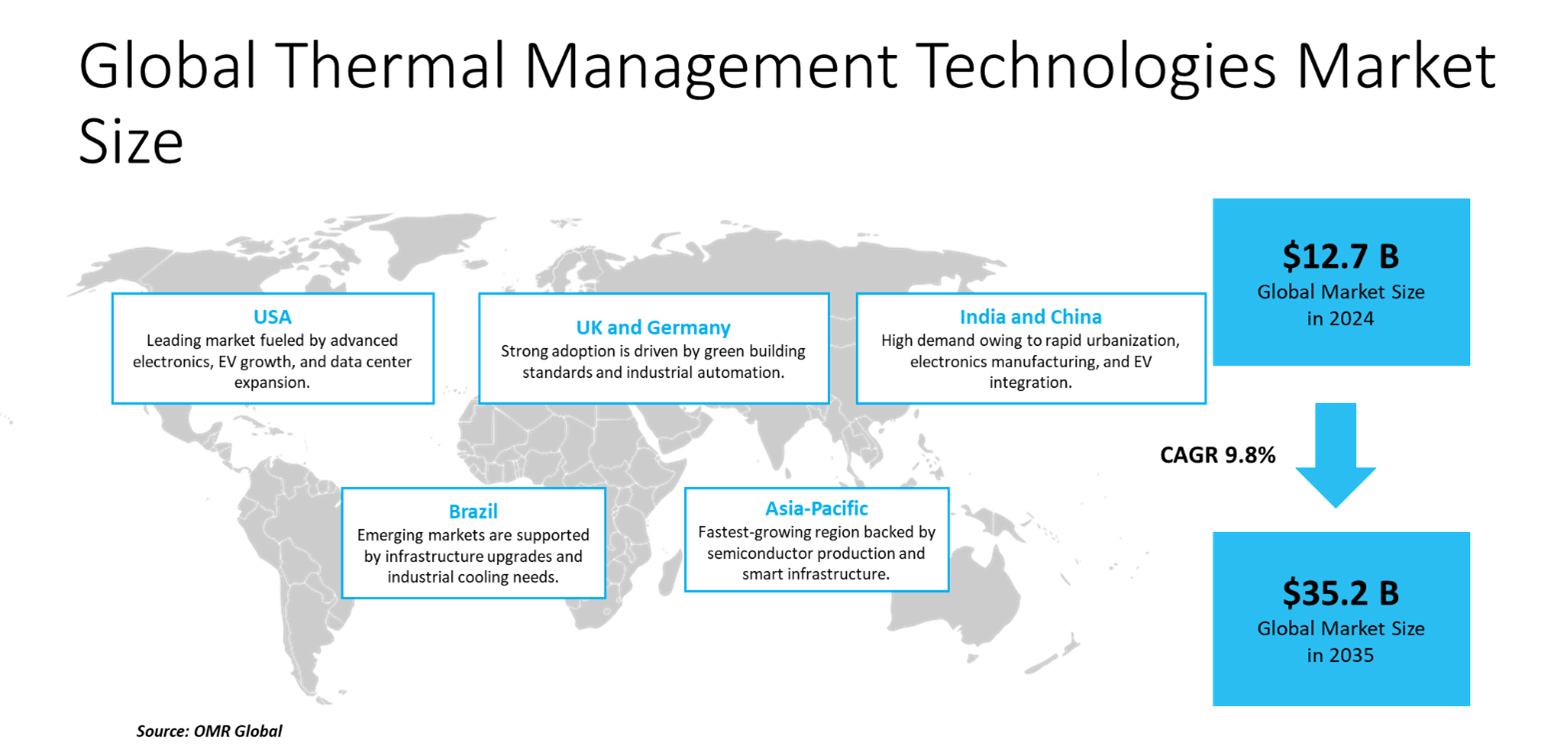
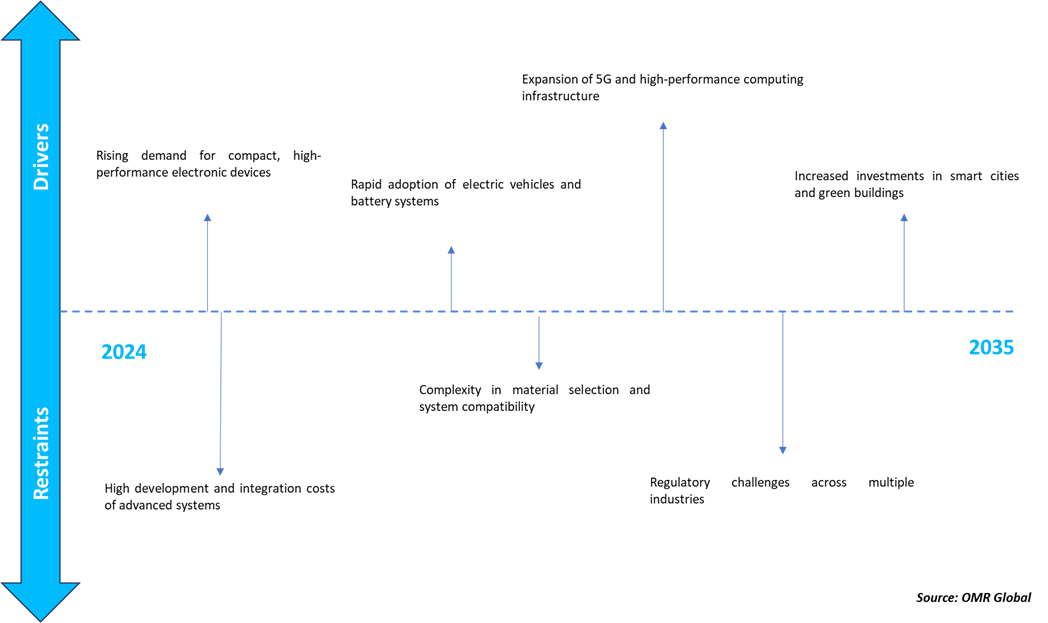
Thermal management technologies market was valued at $12.7 billion in 2024 and is projected to reach $35.2 billion by 2035, growing at a CAGR of 9.8% during the forecast period (2025-2035). The thermal management technologies market is growing due to factors such as the rising demand for high-performance electronic systems across multiple industries. As the industry continues to maintain effective thermal management, it is essential to maintain its dependability. This tendency of creating more compact and powerful devices, together with the rising levels of electric vehicle adoption and renewable energy systems, is all contributing to the need for enhanced cooling solutions. The increasing regulatory scrutiny of energy efficiency and emissions is driving sectors to turn to more robust thermal technologies.
Market Dynamics
Integration of Smart and Predictive Systems
These technology helps with real-time monitoring and data-driven control of thermal performance across a suite of operations. Systems can utilize detectors and smarter software to autonomously manage cooling to avoid failures due to heat, while optimizing operating efficiency. Prophetic analytics further enables early discovery of performance degeneration, reducing the threat of system failures and unplanned time-outs. Industries can leverage similar adaptive thermal approaches to get reduced conservation costs and longer vesting lifetimes. This parallels the broader demonstrable movement toward robotization and intelligent structure. Improved connectivity enables remote operation and diagnostics and has added functional adaptability. For instance, Schneider Electric SE has an intelligent structure and energy operation results that use predictive thermal controls to optimize system performance under marketable or artificial environments.
Growing Adoption of Miniaturized Cooling Techniques
The accelerated growth of thermal management technologies is driven by the growing need for small footprint cooling approaches. As devices in corresponding sectors as electronics, medical, and aerospace, grow smaller in size, while still increasing in function, maintaining thermal characteristics within the accompanying small size is vital. Miniaturized cooling systems are elevated as an efficacious heat dissipation solution while maintaining design and performance. They increase the reliable operation and life span of miniature components, with the major concern being from within high-viscosity environments. The small size and light-weight delivery aspects allow modern product designs more flexibility. The demand for outstanding performance of micro-area thermal management leads to developments in small volumetric thermal interface materials and micro channel heat sinks. For instance, Advanced Cooling Technologies, Inc. specializes in miniature heat pipes and vapor chambers designed for compact electronic devices, ensuring effective thermal regulation in space-constrained surroundings.
Market Segmentation
- Based on the material type, the market is segmented into adhesive materials, and non-adhesive materials.
- Based on the device, the market is segmented into conduction cooling devices, convection cooling devices, advanced cooling devices, and hybrid cooling devices.
- Based on the service, the market is segmented into installation & calibration, and optimization & post-sales support.
- Based on the end-user, the market is segmented into consumer electronics, servers & data centers, automotive, aerospace & defense, enterprises, and others (healthcare).
Non-Adhesive Materials Segment to Lead the Market with the Largest Share
The thermal management technologies market growth is driven by the accelerating use of non-adhesive materials across different industries. Thermal materials are important for their exceptional thermal conductivity and mechanical hardness that makes them ideal for high-performance systems. They are particularly significant in applications that necessitate efficient heat transfer and low thermal degradation over a period of time. Industries such as automotive, aerospace, and telecommunications are embracing non-adhesive results to preserve the stability of the elements and mitigate overheating, while simultaneously providing for easier repair and relief as needed, maximizing long-term value. The proliferation of miniaturization of electronics is contributing to the need for small, effective thermal materials. Their rigidity to different environmental conditions correspondingly adds to their appeal in charge-critical operations. For instance, Henkel AG & Co. KGaA offers a wide range of non-adhesive thermal interface materials that are engineered to optimize heat flow in advanced electronic assemblies.
Consumer Electronics: A Key Segment in Market Growth
The growth of thermal management technologies has been largely linked to the advanced consumer electronics industry. As devices developed smaller, more important, and point-rich, managing heat generation has become a critical design consideration. Rising overheating-related issues have implications for performance and product persistence, and the momentum behind this is driven by manufacturers needing to deliver effective thermal control that involves designing high-performance smartphones, laptops, wearables, and gaming systems that need paraphernalia and systems that can dissipate heat efficiently and employ little space without sacrificing function. The demand for thin and light consumer devices is enabling the need for small and compact thermal materials to perform accordingly. Manufacturers want to progressively incorporate technology to include smart thermal detectors and allow for heat dissipation outcomes directly into product design. Major manufacturers, such as DuPont de Nemours, Inc., have multiple specialty thermal interface materials typically found in high-tech consumer electronics to enable effective heat management and reliability.
Regional Outlook
The global thermal management technologies market is further divided by geography, including North America (the US and Canada), Europe (the UK, Germany, France, Italy, Spain, Russia, and the Rest of Europe), Asia-Pacific (India, China, Japan, South Korea, Australia and New Zealand, ASEAN Countries, and the Rest of Asia-Pacific), and the Rest of the World (the Middle East & Africa, and Latin America).
Growing Demand for Scalable Thermal Solution in North America
The North America thermal management technologies market growth is owing to a strong emphasis on energy efficiency, technological innovation, and regulatory compliance. The region’s advanced structure and high penetration of data centers are creating a compatible demand for dependable and scalable thermal results. The roll out of 5G infrastructure and high density data centers has been required precision heating management. Government regulations surrounding energy efficiency and emissions limitations are forcing manufacturers to consider cost-effective cooling systems. In addition, the expansion of smart manufacturing and the emergence of plant robots are enabling new markets for thermal management solutions. For instance, Honeywell International Inc., captures the demands of advance thermal interface materials and cooling systems that evolve in high-performance applications in markets throughout the region.
Asia-Pacific Region Dominates the Market with Major Share
The Asia-Pacific market for thermal management technologies is growing owing to several pivotal factors, such as rapid industrialization across emerging economies has led to increased demand for effective thermal key solutions in the manufacturing and processing sectors. The region's strong electronics and semiconductor industry requires advanced heat operation systems to support high-performance devices. Government organizations working to promote energy-efficient buildings and green buildings are facilitating the acceptance of smart thermal technologies. Meanwhile, urbanization leads to further construction conditioning, increasing the need for sustainable building systems. Countries such as China, Japan, and South Korea are investing a lot of capital in data centers and smart cities and require thermal management.
Market Players Outlook
The major companies operating in the global thermal management technologies market include Boyd Corp. (LTI Holdings Inc.), DuPont de Nemours, Inc. (Laird Technologies, Inc.), Henkel AG & Co. KGaA, Honeywell International Inc., and Parker-Hannifin Corp., among others. Market players are leveraging partnerships, collaborations, mergers, and acquisition strategies for business expansion and innovative product development to maintain their market positioning.
Recent Developments
- In June 2025, ZF launched a thermal management system for electric vehicles that can improve driving range by over 10%. This system, named TherMaS, has been designed for optimal temperature management of both cabin and battery temperatures, as well as for optimum integration/additional capability factors to improve vehicle performance for both drivers and passengers.
- In May 2025, Freudenberg Sealing Technologies introduced thermal management materials at the Battery Show Europe 2025. Such materials allow for electrical insulation and effective thermal management to offer rapid-fire charging and advanced battery capacity to electric vehicles. Their results feature vibration-resistant connectors and are designed for flexible integration into client-specific product processes, addressing challenges such as fast charging, longer battery life, and precise thermal control.
- In February 2025, Eberspaecher ensures comfort and safety in construction machinery at all temperatures. The thermal operation expert presented its comprehensive portfolio of electric, hybrid, and conventional drives at Bauma. The integrated thermal operation systems for the vehicle, battery, and engine are customized for the client. As a result, the temperature of the traction battery battery thermal management system and the electric motor can be controlled separately or combined with the cabin thermal management system.
The Report Covers
- Market value data analysis of 2024 and forecast to 2035.
- Annualized market revenues ($ million) for each market segment.
- Country-wise analysis of major geographical regions.
- Key companies operating in the global thermal management technologies market. Based on the availability of data, information related to new products and relevant news is also available in the report.
- Analysis of business strategies by identifying the key market segments positioned for strong growth in the future.
- Analysis of market-entry and market expansion strategies.
- Competitive strategies by identifying ‘who-stands-where’ in the market.
- Report Summary
- Current Industry Analysis and Growth Potential Outlook
- Global Thermal Management Technologies Market Sales Analysis – Material Type | Device | Service | End-User ($ Million)
- Thermal Management Technologies Market Sales Performance of Top Countries
- Research Methodology
- Primary Research Approach
- Secondary Research Approach
- Market Snapshot
- Market Overview and Insights
- Scope of the Study
- Analyst Insight & Current Market Trends
- Key Thermal Management Technologies Market Trends
- Market Recommendations
- Porter's Five Forces Analysis for the Thermal Management Technologies Market
- Competitive Rivalry
- Threat of New Entrants
- Bargaining Power of Suppliers
- Bargaining Power of Buyers
- Threat of Substitutes
- Market Determinants
- Market Drivers
- Drivers For Global Thermal Management Technologies Market: Impact Analysis
- Market Pain Points and Challenges
- Restraints For Global Thermal Management Technologies Market: Impact Analysis
- Market Opportunities
- Opportunities For Global Thermal Management Technologies Market: Impact Analysis
- Market Drivers
- Competitive Landscape
- Competitive Dashboard – Thermal Management Technologies Market Revenue and Share by Manufacturers
- Thermal Management Technologies Product Comparison Analysis
- Top Market Player Ranking Matrix
- Key Company Analysis
- Boyd Corp. (LTI Holdings Inc.)
- Overview
- Product Portfolio
- Financial Analysis (Subject to Data Availability)
- SWOT Analysis
- Business Strategy
- DuPont de Nemours, Inc. (Laird Technologies, Inc.)
- Overview
- Product Portfolio
- Financial Analysis (Subject to Data Availability)
- SWOT Analysis
- Business Strategy
- Henkel AG & Co. KGaA
- Overview
- Product Portfolio
- Financial Analysis (Subject to Data Availability)
- SWOT Analysis
- Business Strategy
- Honeywell International Inc.
- Overview
- Product Portfolio
- Financial Analysis (Subject to Data Availability)
- SWOT Analysis
- Business Strategy
- Parker-Hannifin Corp.
- Overview
- Product Portfolio
- Financial Analysis (Subject to Data Availability)
- SWOT Analysis
- Business Strategy
- Top Winning Strategies by Market Players
- Merger and Acquisition
- Product Launch
- Partnership And Collaboration
- Boyd Corp. (LTI Holdings Inc.)
- Key Company Analysis
- Global Thermal Management Technologies Market Sales Analysis by Material Type ($ Million)
- Adhesive Materials
- Non-adhesive Materials
- Global Thermal Management Technologies Market Sales Analysis by Device ($ Million)
- Conduction Cooling Devices
- Convection Cooling Devices
- Advanced Cooling Devices
- Hybrid Cooling Devices
- Global Thermal Management Technologies Market Sales Analysis by Service ($ Million)
- Installation & Calibration
- Optimization & Post-Sales Support
- Global Thermal Management Technologies Market Sales Analysis by End-User ($ Million)
- Consumer Electronics
- Servers & Data Centers
- Automotive
- Aerospace & Defense
- Enterprises
- Others (Healthcare)
- Regional Analysis
- North American Thermal Management Technologies Market Sales Analysis – Material Type | Device | Service | End-User | Country ($ Million)
- Macroeconomic Factors for North America
- United States
- Canada
- European Thermal Management Technologies Market Sales Analysis – Material Type | Device | Service | End-User | Country ($ Million)
- Macroeconomic Factors for Europe
- UK
- Germany
- Italy
- Spain
- France
- Russia
- Rest of Europe
- Asia-Pacific Thermal Management Technologies Market Sales Analysis – Material Type | Device | Service | End-User | Country ($ Million)
- Macroeconomic Factors for Asia-Pacific
- China
- Japan
- South Korea
- India
- Australia & New Zealand
- ASEAN Countries (Thailand, Indonesia, Vietnam, Singapore, And Other)
- Rest of Asia-Pacific
- Rest of the World Thermal Management Technologies Market Sales Analysis – Material Type | Device | Service | End-User| Country ($ Million)
- Macroeconomic Factors for the Rest of the World
- Latin America
- Middle East and Africa
- Company Profiles
- 3M Company
- Quick Facts
- Company Overview
- Product Portfolio
- Business Strategies
- Advanced Cooling Technologies, Inc.
- Quick Facts
- Company Overview
- Product Portfolio
- Business Strategies
- Advanced Thermal Solutions, Inc.
- Quick Facts
- Company Overview
- Product Portfolio
- Business Strategies
- ARCTIC GmbH
- Quick Facts
- Company Overview
- Product Portfolio
- Business Strategies
- Asetek, Inc.
- Quick Facts
- Company Overview
- Product Portfolio
- Business Strategies
- Boyd Corp. (LTI Holdings Inc.)
- Quick Facts
- Company Overview
- Product Portfolio
- Business Strategies
- Cooler Master Technology Inc.
- Quick Facts
- Company Overview
- Product Portfolio
- Business Strategies
- CTS Corp.
- Quick Facts
- Company Overview
- Product Portfolio
- Business Strategies
- DAIKIN Industries, Ltd.
- Quick Facts
- Company Overview
- Product Portfolio
- Business Strategies
- Delta Electronics, Inc.
- Quick Facts
- Company Overview
- Product Portfolio
- Business Strategies
- DuPont de Nemours, Inc. (Laird Technologies, Inc.)
- Quick Facts
- Company Overview
- Product Portfolio
- Business Strategies
- Fujipoly America Corp.
- Quick Facts
- Company Overview
- Product Portfolio
- Business Strategies
- General Electric Co. (GE Aerospace)
- Quick Facts
- Company Overview
- Product Portfolio
- Business Strategies
- Henkel AG & Co. KGaA
- Quick Facts
- Company Overview
- Product Portfolio
- Business Strategies
- Honeywell International Inc.
- Quick Facts
- Company Overview
- Product Portfolio
- Business Strategies
- Infineon Technologies AG
- Quick Facts
- Company Overview
- Product Portfolio
- Business Strategies
- Intel Corp.
- Quick Facts
- Company Overview
- Product Portfolio
- Business Strategies
- Master Bond Inc.
- Quick Facts
- Company Overview
- Product Portfolio
- Business Strategies
- Modine Manufacturing Company
- Quick Facts
- Company Overview
- Product Portfolio
- Business Strategies
- Noctua GmbH
- Quick Facts
- Company Overview
- Product Portfolio
- Business Strategies
- Parker-Hannifin Corp.
- Quick Facts
- Company Overview
- Product Portfolio
- Business Strategies
- Rittal LLC
- Quick Facts
- Company Overview
- Product Portfolio
- Business Strategies
- Samsung Electronics Co., Ltd.
- Quick Facts
- Company Overview
- Product Portfolio
- Business Strategies
- Schneider Electric SE
- Quick Facts
- Company Overview
- Product Portfolio
- Business Strategies
- Thermal Management Technologies
- Quick Facts
- Company Overview
- Product Portfolio
- Business Strategies
- Thermalright
- Quick Facts
- Company Overview
- Product Portfolio
- Business Strategies
- Vertiv Group Corp.
- Quick Facts
- Company Overview
- Product Portfolio
- Business Strategies
- Zalman Tech Co., Ltd.
- Quick Facts
- Company Overview
- Product Portfolio
- Business Strategies
- 3M Company
1. Global Thermal Management Technologies Market Research and Analysis by Material Type, 2024–2035 ($ Million)
2. Global Thermal Adhesive Materials Management Technologies Market Research and Analysis by Region, 2024–2035 ($ Million)
3. Global Thermal Non-Adhesive Materials Management Technologies Market Research and Analysis by Region, 2024–2035 ($ Million)
4. Global Thermal Management Technologies Market Research and Analysis by Device, 2024–2035 ($ Million)
5. Global Thermal Conduction Cooling Devices Management Technologies Market Research and Analysis by Region, 2024–2035 ($ Million)
6. Global Thermal Convection Cooling Devices Management Technologies Market Research and Analysis by Region, 2024–2035 ($ Million)
7. Global Thermal Advanced Cooling Devices Management Technologies Market Research and Analysis by Region, 2024–2035 ($ Million)
8. Global Thermal Hybrid Cooling Devices Management Technologies Market Research and Analysis by Service, 2024–2035 ($ Million)
9. Global Thermal Management Technologies Market Research and Analysis by Service, 2024–2035 ($ Million)
10. Global Thermal Installation & Calibration Management Technologies Market Research and Analysis by Region, 2024–2035 ($ Million)
11. Global Thermal Optimization & Post-Sales Support Management Technologies Market Research and Analysis by Region, 2024–2035 ($ Million)
12. Global Thermal Management Technologies Market Research and Analysis by End-User, 2024–2035 ($ Million)
13. Global Thermal Management Technologies For Consumer Electronics Market Research and Analysis by Region, 2024–2035 ($ Million)
14. Global Thermal Management Technologies For Servers & Data Centers Market Research and Analysis by Region, 2024–2035 ($ Million)
15. Global Thermal Management Technologies For Automotive Market Research and Analysis by Region, 2024–2035 ($ Million)
16. Global Thermal Management Technologies For Aerospace & Defense Market Research and Analysis by Region, 2024–2035 ($ Million)
17. Global Thermal Management Technologies For Enterprises Market Research and Analysis by Region, 2024–2035 ($ Million)
18. Global Thermal Management Technologies For Other End-User Market Research and Analysis by Region, 2024–2035 ($ Million)
19. Global Thermal Management Technologies Market Research and Analysis by Region, 2024–2035 ($ Million)
20. North American Thermal Management Technologies Market Research and Analysis by Country, 2024–2035 ($ Million)
21. North American Thermal Management Technologies Market Research and Analysis by Material Type, 2024–2035 ($ Million)
22. North American Thermal Management Technologies Market Research and Analysis by Device, 2024–2035 ($ Million)
23. North American Thermal Management Technologies Market Research and Analysis by Service, 2024–2035 ($ Million)
24. North American Thermal Management Technologies Market Research and Analysis by End-User, 2024–2035 ($ Million)
25. European Thermal Management Technologies Market Research and Analysis by Country, 2024–2035 ($ Million)
26. European Thermal Management Technologies Market Research and Analysis by Material Type, 2024–2035 ($ Million)
27. European Thermal Management Technologies Market Research and Analysis by Device, 2024–2035 ($ Million)
28. European Thermal Management Technologies Market Research and Analysis by Service, 2024–2035 ($ Million)
29. European Thermal Management Technologies Market Research and Analysis by End-User, 2024–2035 ($ Million)
30. Asia-Pacific Thermal Management Technologies Market Research and Analysis by Country, 2024–2035 ($ Million)
31. Asia-Pacific Thermal Management Technologies Market Research and Analysis by Material Type, 2024–2035 ($ Million)
32. Asia-Pacific Thermal Management Technologies Market Research and Analysis by Device, 2024–2035 ($ Million)
33. Asia-Pacific Thermal Management Technologies Market Research and Analysis by Service, 2024–2035 ($ Million)
34. Asia-Pacific Thermal Management Technologies Market Research and Analysis by End-User, 2024–2035 ($ Million)
35. Rest of the World Thermal Management Technologies Market Research and Analysis by Region, 2024–2035 ($ Million)
36. Rest of the World Thermal Management Technologies Market Research and Analysis by Material Type, 2024–2035 ($ Million)
37. Rest of the World Thermal Management Technologies Market Research and Analysis by Device, 2024–2035 ($ Million)
38. Rest of the World Thermal Management Technologies Market Research and Analysis by Service, 2024–2035 ($ Million)
39. Rest of the World Thermal Management Technologies Market Research and Analysis by End-User, 2024–2035 ($ Million)
1. Global Thermal Management Technologies Market Share by Material Type, 2024 Vs 2035 (%)
2. Global Thermal Adhesive Materials Management Technologies Market Share by Region, 2024 Vs 2035 (%)
3. Global Thermal Non-Adhesive Materials Management Technologies Market Share by Region, 2024 Vs 2035 (%)
4. Global Thermal Management Technologies Market Share by Device, 2024 Vs 2035 (%)
5. Global Thermal Conduction Cooling Devices Management Technologies Market Share by Region, 2024 Vs 2035 (%)
6. Global Thermal Convection Cooling Devices Management Technologies Market Share by Region, 2024 Vs 2035 (%)
7. Global Thermal Advanced Cooling Devices Management Technologies Market Share by Region, 2024 Vs 2035 (%)
8. Global Thermal Hybrid Cooling Devices Management Technologies Market Share by Region, 2024 Vs 2035 (%)
9. Global Thermal Management Technologies Market Share by Service, 2024 Vs 2035 (%)
10. Global Thermal Installation & Calibration Management Technologies Market Share by Region, 2024 Vs 2035 (%)
11. Global Thermal Optimization & Post-Sales Support Management Technologies Market Share by Region, 2024 Vs 2035 (%)
12. Global Thermal Management Technologies Market Share by End-User, 2024 Vs 2035 (%)
13. Global Thermal Management Technologies For Consumer Electronics Market Share by Region, 2024 Vs 2035 (%)
14. Global Thermal Management Technologies For Servers & Data Centers Market Share by Region, 2024 Vs 2035 (%)
15. Global Thermal Management Technologies For Automotive Market Share by Region, 2024 Vs 2035 (%)
16. Global Thermal Management Technologies For Aerospace & Defense Market Share by Region, 2024 Vs 2035 (%)
17. Global Thermal Management Technologies For Enterprises Market Share by Region, 2024 Vs 2035 (%)
18. Global Thermal Management Technologies For Other End-User Market Share by Region, 2024 Vs 2035 (%)
19. Global Thermal Management Technologies Market Share by Region, 2024 Vs 2035 (%)
20. US Thermal Management Technologies Market Size, 2024–2035 ($ Million)
21. Canada Thermal Management Technologies Market Size, 2024–2035 ($ Million)
22. UK Thermal Management Technologies Market Size, 2024–2035 ($ Million)
23. France Thermal Management Technologies Market Size, 2024–2035 ($ Million)
24. Germany Thermal Management Technologies Market Size, 2024–2035 ($ Million)
25. Italy Thermal Management Technologies Market Size, 2024–2035 ($ Million)
26. Spain Thermal Management Technologies Market Size, 2024–2035 ($ Million)
27. Russia Thermal Management Technologies Market Size, 2024–2035 ($ Million)
28. Rest of Europe Thermal Management Technologies Market Size, 2024–2035 ($ Million)
29. India Thermal Management Technologies Market Size, 2024–2035 ($ Million)
30. China Thermal Management Technologies Market Size, 2024–2035 ($ Million)
31. Japan Thermal Management Technologies Market Size, 2024–2035 ($ Million)
32. South Korea Thermal Management Technologies Market Size, 2024–2035 ($ Million)
33. Australia and New Zealand Thermal Management Technologies Market Size, 2024–2035 ($ Million)
34. ASEAN Economies Thermal Management Technologies Market Size, 2024–2035 ($ Million)
35. Rest of Asia-Pacific Thermal Management Technologies Market Size, 2024–2035 ($ Million)
36. Latin America Thermal Management Technologies Market Size, 2024–2035 ($ Million)
37. Middle East and Africa Thermal Management Technologies Market Size, 2024–2035 ($ Million)
- Printable version
- No restriction to number of users within the company