Waste Management Market


Waste Management Market Size, Share & Trends Analysis Report by Waste Type (Non-Hazardous Industrial Waste, Municipal Solid Waste, Hazardous Waste, E-Waste, Plastic Waste, Bio-Medical Waste, and Others), by Disposal Methods (Open Dumping, Landfills, Incineration/ Combustion, Recycling, and Composting and Anaerobic Digestion), and by Source (Residential, Commercial, and Industrial) Forecast Period (2025-2035)
Industry Overview
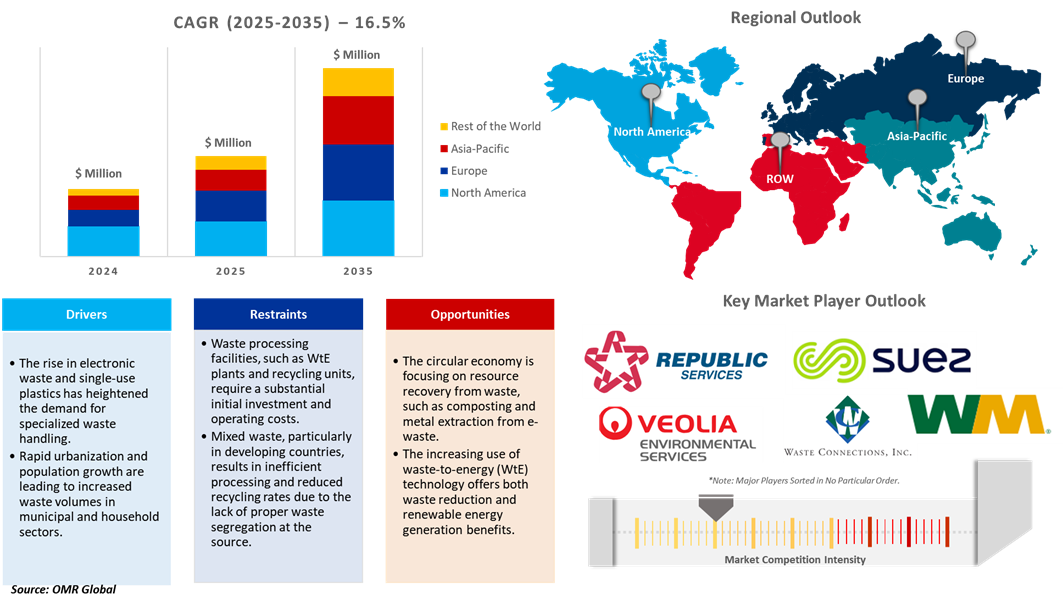
Waste management market was valued at $524.6 billion in 2024 and is projected to reach $2,798.7 billion by 2035, growing at a CAGR of 16.5% during the forecast period (2025–2035). Waste management is the systematic process of collecting, conveying, treating, recycling, and landfilling waste with a view to minimizing their environmental, health, and social effects so that they can be managed sustainably throughout their life cycle. It contributes to environmental preservation, resource conservation, public health, economic benefits, energy conservation, compliance, sustainable development, and community welfare by encouraging recycling, conserving fossil fuels, and promoting a circular economy. It comprises safe collection, disposal, recycling, resource recovery, and appropriate collection routes across diverse businesses to preserve environmental regulations and reduce the pressure on landfills.
Market Dynamics
Rising Global E-Waste Generation and the Growing Recycling Gap
E-waste is the discarded electrical and electronic equipment (EEE) and parts, such as consumer electronics, domestic appliances, office equipment, lighting, tools, toys, and medical devices, additionally referred to as WEEE or e-scrap. Market development is stimulated by growing e-waste, reduced device lifetimes, and expanding digital consumption fueled by rapid technological advancements. According to the United Nations Institute for Training and Research (UNITAR), in 2024, a record 62 million tons of electrical waste was produced, up 82% from 2010, and is predicted to increase further 32% to 82 million tons by 2030. As little as 22.3% of the e-waste was actually collected and recycled, with $62 billion of recoverable resources going unreported, and developing environmental and health hazards through toxic chemicals. The report forecasts a drop in the recorded recycling rate to 20% by 2030 as e-waste production continues to surpass recycling activities owing to such drivers as technological change, enhanced consumption, and poor infrastructure.
Technological Advancements Driving Innovation in Waste Processing and Waste-to-Energy Solutions
The expansion of the waste management market is largely propelled by technological advances in waste processing technologies and innovation in waste-to-energy power generation. Such advancements are facilitating more effective recovery of resources, reducing landfill reliance, and enabling circular economy processes. Governments, private industry, and urban local bodies are making major investments in integrated waste management systems that include collection, segregation, recycling, composting, and the generation of energy. In February 2024, Re Sustainability inaugurated a new waste-to-energy plant in Rewa, strengthening its global position as a Sustainable Solutions provider, with the involvement of 28 Urban Local Bodies. The Integrated regional solid waste management plant, with a coverage of 2,35,000 households, provides door-to-door collection, transportation, processing, and disposal services. It comprises RDF, composting, recycling, landfilling, and a 6 MW waste-to-energy facility. The project is designed on a build, own, and operate basis, with a capital assistance of $10.4 million. Future expansion options include adding another 6 MW of power.
Market Segmentation
- Based on the product, the market is segmented into non-hazardous industrial waste, municipal solid waste, hazardous waste, e-waste, plastic waste, bio-medical waste, and others.
- Based on the disposal methods, the market is segmented into open dumping, landfills, incineration/ combustion, recycling, composting, and anaerobic digestion.
- Based on the source, the market is segmented into residential, commercial, and industrial.
Municipal Solid Waste: A Key Segment in Market Growth
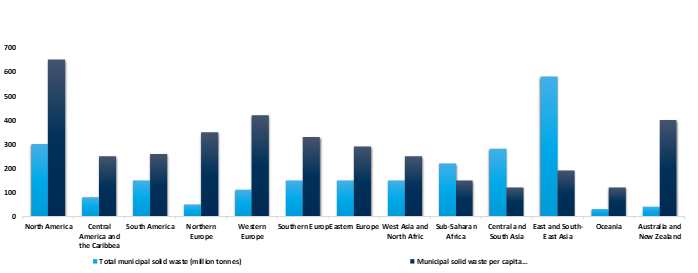
Municipal solid waste (MSW) refers to non-liquid domestic, commercial, institutional, and industrial waste generated by households, businesses, institutions, and commercial activities, also called trash or garbage. Furthermore, MSW garbage, such as food waste, plastics, paper, textiles, e-waste, and furniture, needs to be managed efficiently for public health, environmental conservation, and resource recovery through collecting, sorting, recycling, composting, incineration, and landfilling. High calorific-value MSW is being used to generate electricity and heat in both developed and developing countries, fuelling market growth. According to the United Nations Human Settlements Programme, 2024, Municipal solid waste generation will increase from 2.1 billion tonnes in 2023 to 3.8 billion tonnes in 2050. The global direct cost of trash management is predicted to be $252 billion in 2020. The entire cost of pollution, health concerns, and global warming was $361 billion. In the absence of coordinated measures, the cost per year globally is expected to effectively double to a value of $640.3 billion by 2050.
MSW generation by region: Total MSW (million tons) and MSW per capita (kg/person/day)
Source: United Nations Human Settlements Programme
Regional Outlook
The global waste management market is further divided by region, including North America (the US and Canada), Europe (the UK, Germany, France, Italy, Spain, Russia, and the Rest of Europe), Asia-Pacific (India, China, Japan, South Korea, Australia and New Zealand, ASEAN Countries, and the Rest of Asia-Pacific), and the Rest of the World (the Middle East & Africa, and Latin America).
Increased Focus On Circular Economy Models in Europe
Market expansion is being driven by an increasing focus on circular economy models, which promote recycling, reuse, and waste-to-resource technology. For instance, in May 2025, the European Commission is set to launch a $51.8 million Horizon Europe scheme to recycle end-of-life waste materials, part of the $10.42 million MOBICCON-PRO project funded under Horizon Europe.
Asia-Pacific Maintains Strong Market Position
Asia-Pacific holds a significant share, owing to the market growth is mainly being led by the market growth is being led by the adoption of new waste management methods, motivated by strict environmental protection regulations and state policies such as the Swachh Bharat Mission. For instance, in March 2025, Indore initiated India's first PPP green waste treatment plant, under Swachh Bharat Mission-Urban. The plant, which was constructed through a Public-Private Partnership (PPP) policy, converted green waste into useful commodities and earned revenue for the Indore Municipal Corporation. The plant recycles branches and wood into wooden pellets, fostering energy conservation and the reuse of large tree branches. The plant also collects and transmits green waste from major institutions at a flat fee. Sawdust, which is utilized in many industries, is being used as an eco-friendly fuel, packaging, fertilizers, and disposable plates. Private companies transfer land and green waste to processing factories, and wood pellets are manufactured.
Market Players Outlook
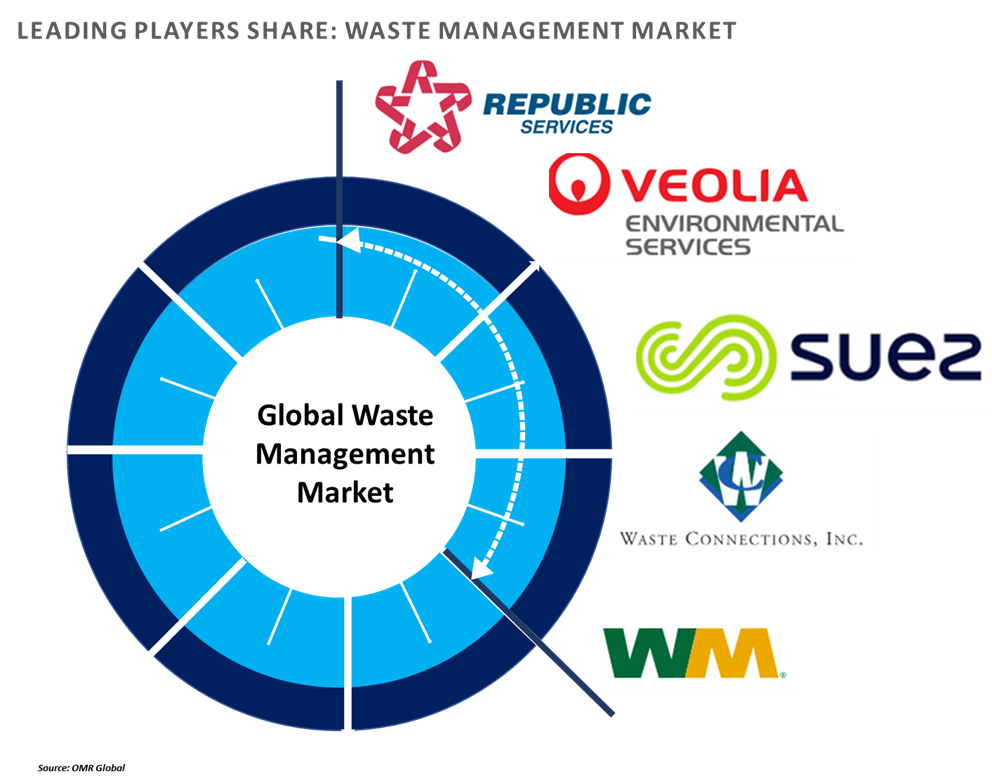
The major companies operating in the global waste management market include Republic Services, SUEZ SA, Veolia Environnement SA, Waste Connections, and Waste Management Service Center, Inc., among others. Market players are leveraging partnerships, collaborations, mergers, and acquisition strategies for business expansion and innovative product development to maintain their market positioning.
Recent Developments
- In July 2025, the European Commission introduced major actions to boost the EU's shift to a circular economy, with a major focus on promoting better resource efficiency and waste reduction. The core action is bringing in a new digital waste shipment system to replace paper-based processes, to simplify cross-border waste flows, and enhance compliance. The other supporting policies will encourage reuse, recycling, and eco-friendly product design, support the struggle against pollution, reduce environmental strain, and make EU industries more competitive.
- In February 2025, India's first indigenous automated biomedical waste treatment plant, s?janam, was inaugurated by a union minister at AIIMS New Delhi. The green technology, developed by CSIR-NIIST, can treat pathogenic biomedical waste using non-energy-intensive incinerators. The rig, with a daily capacity of 400 kg, can treat 10 kg of degradable medical waste per day. The technology has been third-party tested for its antimicrobial efficacy.
The Report Covers
- Market value data analysis of 2024 and forecast to 2035.
- Annualized market revenues ($ million) for each market segment.
- Country-wise analysis of major geographical regions.
- Key companies operating in the global waste management market. Based on the availability of data, information related to new products and relevant news is also available in the report.
- Analysis of business strategies by identifying the key market segments positioned for strong growth in the future.
- Analysis of market-entry and market expansion strategies.
- Competitive strategies by identifying ‘who-stands-where’ in the market.
- Report Summary
- Current Industry Analysis and Growth Potential Outlook
- Global Waste Management Market Sales Analysis – Waste Type | Disposal Methods | Source ($ Million)
- Waste Management Market Sales Performance of Top Countries
- Research Methodology
- Primary Research Approach
- Secondary Research Approach
- Market Snapshot
- Market Overview and Insights
- Scope of the Study
- Analyst Insight & Current Market Trends
- Key Waste Management Market Trends
- Market Recommendations
- Market Determinants
- Market Drivers
- Drivers For Global Waste Management Market: Impact Analysis
- Market Pain Points and Challenges
- Restraints For Global Waste Management Market: Impact Analysis
- Market Opportunities
- Opportunities For Global Waste Management Market: Impact Analysis
- Market Drivers
- Competitive Landscape
- Competitive Dashboard – Waste Management Market Revenue and Share by Manufacturers
- Waste Management Comparison Analysis
- Top Market Player Ranking Matrix
- Key Company Analysis
- Republic Services
- Overview
- Waste Type Portfolio
- Financial Analysis (Subject to Data Availability)
- SWOT Analysis
- Business Strategy
- SUEZ SA.
- Overview
- Waste Type Portfolio
- Financial Analysis (Subject to Data Availability)
- SWOT Analysis
- Business Strategy
- Veolia Environnement SA
- Overview
- Waste Type Portfolio
- Financial Analysis (Subject to Data Availability)
- SWOT Analysis
- Business Strategy
- Waste Connections
- Overview
- Waste Type Portfolio
- Financial Analysis (Subject to Data Availability)
- SWOT Analysis
- Business Strategy
- Waste Management Service Center, Inc.
- Overview
- Waste Type Portfolio
- Financial Analysis (Subject to Data Availability)
- SWOT Analysis
- Business Strategy
- Republic Services
- Key Company Analysis
- Top Winning Strategies by Market Players
- Merger and Acquisition
- Waste Type Launch
- Partnership And Collaboration
- Global Waste Management Market Sales Analysis by Waste Type ($ Million)
- Non-Hazardous Industrial Waste
- Municipal Solid Waste
- Hazardous Waste
- E-Waste
- Plastic Waste
- Bio-Medical Waste
- Others
- Global Waste Management Market Sales Analysis by Disposal Methods ($ Million)
- Open Dumping
- Landfills
- Incineration/ Combustion
- Recycling
- Composting and Anaerobic Digestion
- Global Waste Management Market Sales Analysis by Source ($ Million)
- Residential
- Commercial
- Industrial
- Regional Analysis
- North American Waste Management Market Sales Analysis – Waste Type | Disposal Methods | Source ($ Million)
- Macroeconomic Factors for North America
- United States
- Canada
- European Waste Management Market Sales Analysis – Waste Type | Disposal Methods | Source ($ Million)
- Macroeconomic Factors for Europe
- UK
- Germany
- Italy
- Spain
- France
- Russia
- Rest of Europe
- Asia-Pacific Waste Management Market Sales Analysis – Waste Type | Disposal Methods | Source ($ Million)
- Macroeconomic Factors for Asia-Pacific
- China
- Japan
- South Korea
- India
- Australia & New Zealand
- ASEAN Countries (Thailand, Indonesia, Vietnam, Singapore, And others)
- Rest of Asia-Pacific
- Rest of the World Waste Management Market Sales Analysis – Waste Type | Disposal Methods | Source ($ Million)
- Macroeconomic Factors for the Rest of the World
- Latin America
- Middle East and Africa
- Company Profiles
- A2Z Waste Management Solutions
- Quick Facts
- Company Overview
- Product Portfolio
- Business Strategies
- Biffa Inc.
- Quick Facts
- Company Overview
- Product Portfolio
- Business Strategies
- Clean Harbors, Inc.
- Quick Facts
- Company Overview
- Product Portfolio
- Business Strategies
- Cleanaway
- Quick Facts
- Company Overview
- Product Portfolio
- Business Strategies
- GFL Environmental Inc.
- Quick Facts
- Company Overview
- Product Portfolio
- Business Strategies
- Grow Billion Trees
- Quick Facts
- Company Overview
- Product Portfolio
- Business Strategies
- Keppel Ltd.
- Quick Facts
- Company Overview
- Product Portfolio
- Business Strategies
- Newater Technology
- Quick Facts
- Company Overview
- Product Portfolio
- Business Strategies
- Recology Inc.
- Quick Facts
- Company Overview
- Product Portfolio
- Business Strategies
- REMONDIS SE & Co. KG
- Quick Facts
- Company Overview
- Product Portfolio
- Business Strategies
- Renewi PLC
- Quick Facts
- Company Overview
- Product Portfolio
- Business Strategies
- Republic Services
- Quick Facts
- Company Overview
- Product Portfolio
- Business Strategies
- Siemens AG.
- Quick Facts
- Company Overview
- Product Portfolio
- Business Strategies
- Stericycle, Inc.
- Quick Facts
- Company Overview
- Product Portfolio
- Business Strategies
- SUEZ SA.
- Quick Facts
- Company Overview
- Product Portfolio
- Business Strategies
- The Shakti Plastic Industries
- Quick Facts
- Company Overview
- Product Portfolio
- Business Strategies
- Veolia Environnement SA
- Quick Facts
- Company Overview
- Product Portfolio
- Business Strategies
- Waste Connections
- Quick Facts
- Company Overview
- Product Portfolio
- Business Strategies
- Waste Management Service Center, Inc.
- Quick Facts
- Company Overview
- Product Portfolio
- Business Strategies
- A2Z Waste Management Solutions
1. Global Waste Management Market Research And Analysis By Waste Type, 2024-2035 ($ Million)
2. Global Non-Hazardous Industrial Waste Management Market Research And Analysis By Region, 2024-2035 ($ Million)
3. Global Municipal Solid Waste Management Market Research And Analysis By Region, 2024-2035 ($ Million)
4. Global Hazardous Waste Management Market Research And Analysis By Region, 2024-2035 ($ Million)
5. Global E-Waste Management Market Research And Analysis By Region, 2024-2035 ($ Million)
6. Global Plastic Waste Management Market Research And Analysis By Region, 2024-2035 ($ Million)
7. Global Bio-Medical Waste Management Market Research And Analysis By Region, 2024-2035 ($ Million)
8. Global Other Waste Type Management Market Research And Analysis By Region, 2024-2035 ($ Million)
9. Global Waste Management Market Research And Analysis By Disposal Methods, 2024-2035 ($ Million)
10. Global Open Dumping Waste Management Market Research And Analysis By Region, 2024-2035 ($ Million)
11. Global Landfills Waste Management Market Research And Analysis By Region, 2024-2035 ($ Million)
12. Global Incineration/ Combustion Waste Management Market Research And Analysis By Region, 2024-2035 ($ Million)
13. Global Recycling Waste Management Market Research And Analysis By Region, 2024-2035 ($ Million)
14. Global Composting And Anaerobic Digestion Market Research And Analysis By Region, 2024-2035 ($ Million)
15. Global Waste Management Market Research And Analysis By Source, 2024-2035 ($ Million)
16. Global Waste Management For Residential Market Research And Analysis By Region, 2024-2035 ($ Million)
17. Global Waste Management For Commercial Market Research And Analysis By Region, 2024-2035 ($ Million)
18. Global Waste Management For Industrial Market Research And Analysis By Region, 2024-2035 ($ Million)
19. Global Waste Management Market Research And Analysis By Region, 2024-2035 ($ Million)
20. North American Waste Management Market Research And Analysis By Country, 2024-2035 ($ Million)
21. North American Waste Management Market Research And Analysis By Waste Type, 2024-2035 ($ Million)
22. North American Waste Management Market Research And Analysis By Disposal Methods, 2024-2035 ($ Million)
23. North American Waste Management Market Research And Analysis By Source, 2024-2035 ($ Million)
24. European Waste Management Market Research And Analysis By Country, 2024-2035 ($ Million)
25. European Waste Management Market Research And Analysis By Waste Type, 2024-2035 ($ Million)
26. European Waste Management Market Research And Analysis By Disposal Methods, 2024-2035 ($ Million)
27. European Waste Management Market Research And Analysis By Source, 2024-2035 ($ Million)
28. Asia-Pacific Waste Management Market Research And Analysis By Country, 2024-2035 ($ Million)
29. Asia-Pacific Waste Management Market Research And Analysis By Waste Type, 2024-2035 ($ Million)
30. Asia-Pacific Waste Management Market Research And Analysis By Disposal Methods, 2024-2035 ($ Million)
31. Asia-Pacific Waste Management Market Research And Analysis By Source, 2024-2035 ($ Million)
32. Rest Of The World Waste Management Market Research And Analysis By Region, 2024-2035 ($ Million)
33. Rest Of The World Waste Management Market Research And Analysis By Waste Type, 2024-2035 ($ Million)
34. Rest Of The World Waste Management Market Research And Analysis By Disposal Methods, 2024-2035 ($ Million)
35. Rest Of The World Waste Management Market Research And Analysis By Source, 2024-2035 ($ Million)
1. Global Waste Management Market Share By Waste Type, 2024 Vs 2035 (%)
2. Global Non-Hazardous Industrial Waste Management Market Share By Region, 2024 Vs 2035 (%)
3. Global Municipal Solid Waste Management Market Share By Region, 2024 Vs 2035 (%)
4. Global Hazardous Waste Management Market Share By Region, 2024 Vs 2035 (%)
5. Global E-Waste Management Market Share By Region, 2024 Vs 2035 (%)
6. Global Plastic Waste Management Market Share By Region, 2024 Vs 2035 (%)
7. Global Bio-Medical Waste Management Market Share By Region, 2024 Vs 2035 (%)
8. Global Other Waste Type Management Market Share By Region, 2024 Vs 2035 (%)
9. Global Waste Management Market Share By Disposal Methods, 2024 Vs 2035 (%)
10. Global Open Dumping Waste Management Solutions Market Share By Region, 2024 Vs 2035 (%)
11. Global Landfills Waste Management Market Share By Region, 2024 Vs 2035 (%)
12. Global Incineration/ Combustion Waste Management Market Share By Region, 2024 Vs 2035 (%)
13. Global Recycling Waste Management Market Share By Region, 2024 Vs 2035 (%)
14. Global Composting And Anaerobic Digestion Waste Management Market Share By Region, 2024 Vs 2035 (%)
15. Global Waste Management Market Share By Source, 2024 Vs 2035 (%)
16. Global Waste Management For Residential Market Share By Region, 2024 Vs 2035 (%)
17. Global Waste Management For Commercial Market Share By Region, 2024 Vs 2035 (%)
18. Global Waste Management For Industrial Market Share By Region, 2024 Vs 2035 (%)
19. US Waste Management Market Size, 2024-2035 ($ Million)
20. Canada Waste Management Market Size, 2024-2035 ($ Million)
21. UK Waste Management Market Size, 2024-2035 ($ Million)
22. France Waste Management Market Size, 2024-2035 ($ Million)
23. Germany Waste Management Market Size, 2024-2035 ($ Million)
24. Italy Waste Management Market Size, 2024-2035 ($ Million)
25. Spain Waste Management Market Size, 2024-2035 ($ Million)
26. Russia Waste Management Market Size, 2024-2035 ($ Million)
27. Rest Of Europe Waste Management Market Size, 2024-2035 ($ Million)
28. India Waste Management Market Size, 2024-2035 ($ Million)
29. China Waste Management Market Size, 2024-2035 ($ Million)
30. Japan Waste Management Market Size, 2024-2035 ($ Million)
31. South Korea Waste Management Market Size, 2024-2035 ($ Million)
32. Australia And New Zealand Waste Management Market Size, 2024-2035 ($ Million)
33. Asean Economies Waste Management Market Size, 2024-2035 ($ Million)
34. Rest Of Asia-Pacific Waste Management Market Size, 2024-2035 ($ Million)
35. Latin America Waste Management Market Size, 2024-2035 ($ Million)
36. Middle East And Africa Waste Management Market Size, 2024-2035 ($ Million)
- Printable version
- No restriction to number of users within the company